Analysis
Democrats got a larger share of their 2026 House and Senate donor money in gifts under $200 than Republicans did
Gifts under $200 made up 41.5% of the Democratic donor money VoteHub mapped through Sept. 30 and 27.2% of the Republican money. The gap held in 12 of 13 Senate races.
Gifts of less than $200 made up 41.5 percent of the donor money VoteHub’s 2026 Donations Map places for Democratic House and Senate candidates from January 2025 through September 2026, and 27.2 percent of the money it places for Republicans. In dollars, Democrats took in $588.7 million in gifts under $200 and Republicans took in $140.0 million, a ratio of about 4.2 to 1.
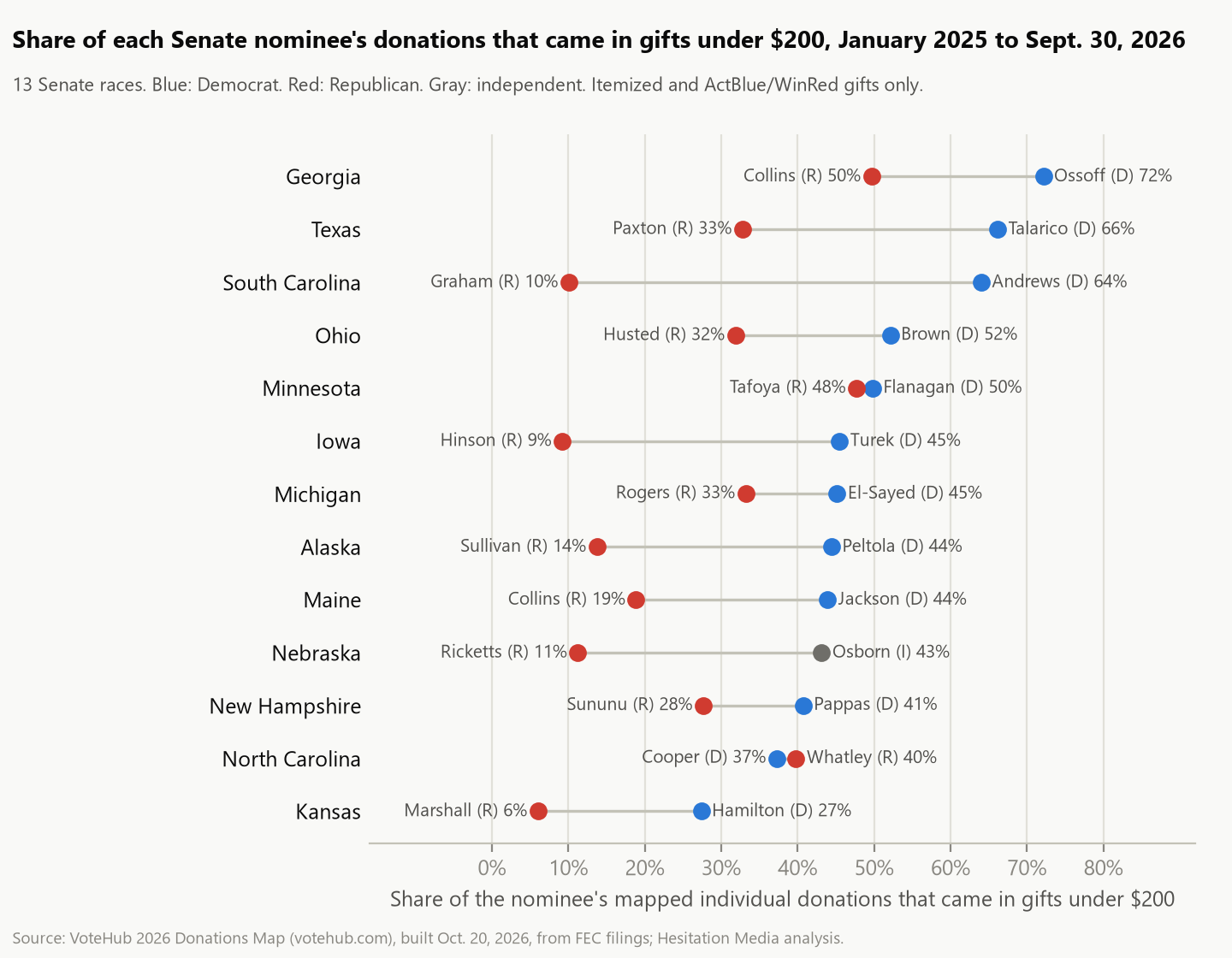
The same gap shows up race by race: In 12 of the 13 Senate races in the chart below, the Democrat or independent got a larger share of mapped donor money in gifts under $200 than the Republican did. The exception was North Carolina: small gifts made up 40 percent of the mapped money for Michael Whatley (R) and 37 percent for Roy Cooper (D).
What the map counts
VoteHub, an election-data site, built the map from Federal Election Commission filings and released it Oct. 24. It counts $1.99 billion in donations to 2026 House and Senate campaigns and places $1.96 billion of it in the county where each donor lives; the rest came from ZIP codes that match no county. The money comes from two kinds of records: gifts that campaigns itemize on their FEC reports, and every gift of any size that passed through ActBlue, the Democratic donation platform, or WinRed, its Republican counterpart. Those two platforms carried $1.42 billion of the $1.99 billion.
“Under $200” here means the size of a single gift, whereas the FEC’s line for unitemized money counts donors whose gifts to a campaign add up to $200 or less over the cycle. A $25 gift through ActBlue from a donor who later gives $500 more counts as under $200 on the map, though the campaign itemizes it.
The map leaves out small gifts sent straight to a campaign that the campaign never itemizes, so it undercounts most for candidates who take small gifts on their own websites, outside ActBlue and WinRed. It also leaves out money from PACs and parties, transfers from joint fundraising committees, and candidates’ own money and loans.
VoteHub’s own write-up of the map also puts Democrats ahead, at higher shares of 44 percent for Democrats and 34 percent for Republicans, because it adds back the direct small gifts the map cannot place on a county. The larger base also lowers the write-up’s shares for big checks, so its figures for gifts of $2,500 or more, 37 percent of Republican money and 25 percent of Democratic money, run below the ones here.
Gift sizes
At the other end, gifts of $2,500 or more made up 40.4 percent of the Republican money on the map and 25.9 percent of the Democratic money. By count, though, most gifts on both sides were small: Of the 41.2 million gifts the map placed on a county, 39.8 million, or 96.7 percent, were under $200, and they averaged $18.44.
How the figures compare with FEC filings
Gift-by-gift totals like the map’s cannot be pulled from the FEC’s summary reports, but the closest line, unitemized individual contributions, roughly matches them for most of the 26 nominees in the chart. The FEC figures run through Oct. 14, two weeks past the map’s end, so a close match is partly chance. Through Oct. 14, James Talarico (D) reported $75.3 million in unitemized contributions; the map shows $75.3 million in gifts under $200 through Sept. 30. Sherrod Brown (D) reported $22.4 million against the map’s $24.4 million, and Annie Andrews (D) reported $12.5 million against $12.1 million.
The two measures split where a campaign takes many small gifts directly. Ashley Hinson (R) reported $1.55 million in unitemized contributions, about three times the $0.52 million in gifts under $200 the map shows for her, and Michele Tafoya (R) reported $5.26 million against $3.07 million. Their shares in the chart are likely too low for that reason. For Jon Ossoff (D), the map’s figure is higher: his campaign reported $55.3 million unitemized, and the map shows $66.1 million in gifts under $200. The likely difference is small ActBlue gifts from donors whose totals passed $200, which the FEC counts as itemized.
The map also covers only part of what some campaigns raised. Cooper (D) reported $49.6 million in receipts through Oct. 14, and $18.0 million of it came from individuals; the map places $15.0 million through Sept. 30. Darline Graham (R), appointed to the Senate after her brother, Lindsey Graham (R), died in July, won the Republican nomination in an Aug. 25 runoff, and the map places $0.6 million for her campaign.
Sources
- VoteHub, 2026 Donations Map, by Ryan McComb, built Oct. 20, 2026; gifts dated Jan. 1, 2025, to Sept. 30, 2026. National and party figures are the sums of the map’s county file; candidate figures are the sums of each candidate’s county file.
- VoteHub, Inside VoteHub’s 2026 Donor Map, Oct. 24, 2026.
- Federal Election Commission, 2026 candidate summary file, downloaded Nov. 4, 2026; most coverage ends Oct. 14, 2026.
Changelog
- Published with VoteHub's 2026 Donations Map as built Oct. 20, 2026, covering gifts dated Jan. 1, 2025, to Sept. 30, 2026. Checked against the FEC's 2026 candidate summary file.
Hesitation Media sends new records to the newsletter first. Subscribe on Substack.