Analysis
Five Congresses, measured: power, approval and law since 2017
Majorities, Gallup approval, bills passed, party-line votes and floor-speech tone for the 115th to 119th Congresses, with how the Beltway press covered each fight.
Between Oct. 1 and Oct. 19, 2026, Gallup asked a national sample of adults whether they approved of the way Congress was handling its job, and 14 percent said they did. In the first half of April the figure had been 10 percent. Gallup’s trend table lists 401 readings since April 1974, and one is lower: 9 percent, in November 2013.
The Congress those numbers describe is the 119th, elected in November 2024 with 220 Republicans and 215 Democrats in the House, the narrowest of the five House majorities elected since 2016. On Nov. 3 voters choose the House that will replace it and at least 33 senators.
The margins
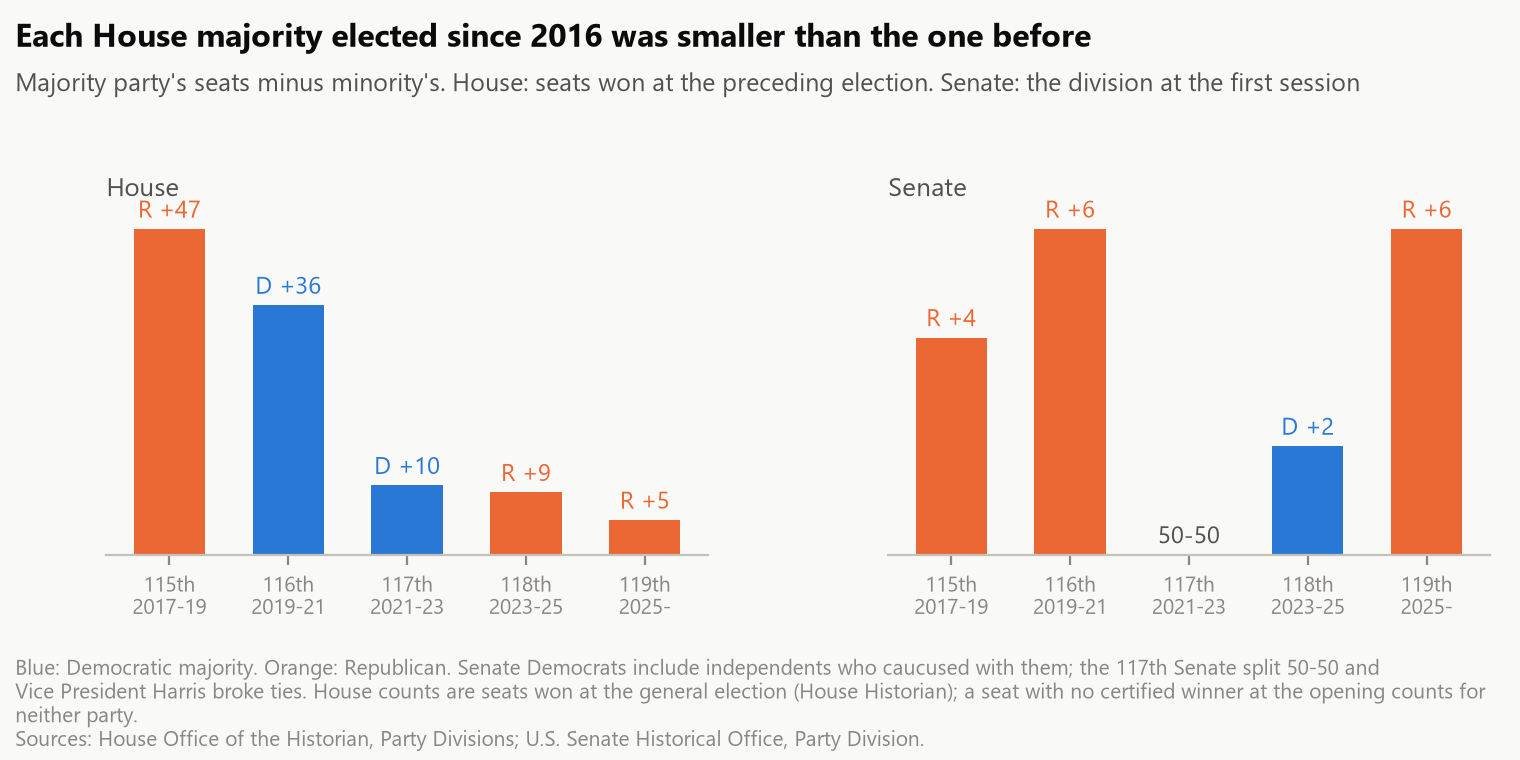
Republicans won 241 House seats in 2016 to the Democrats’ 194, a margin of 47. Each House elected since has had a smaller one. Democrats won the 116th Congress with 235 seats to 199, a margin of 36, and kept the 117th with 222 to 212. Republicans won the 118th 222 to 213 and the 119th 220 to 215. In two of those Congresses a seat counted for neither party at the opening because a state had not certified its winner: North Carolina’s Ninth District in January 2019 and New York’s 22nd in January 2021. Seats change hands after an election too; on Jan. 3, 2025, Matt Gaetz’s Florida seat was vacant, and 219 Republicans voted in the election for speaker.
The Senate moved in a narrower band. Republicans held 52 seats in the 115th and 53 in the 116th. The 117th split 50 to 50 once Georgia’s two runoff winners were seated on Jan. 20, 2021, and Vice President Kamala Harris broke ties for the Democrats. Democrats held 51 seats in the 118th, counting the independents who caucused with them, and Republicans returned to 53 in the 119th.
Three of the five Congresses placed the White House, the House and the Senate under one party: the 115th, in President Donald Trump’s first term; the 117th, in President Joe Biden’s, with the Senate held by the vice president’s vote; and the 119th, in Trump’s second term. Each of the three used budget reconciliation to pass at least one law without a vote from the other party.
The approval
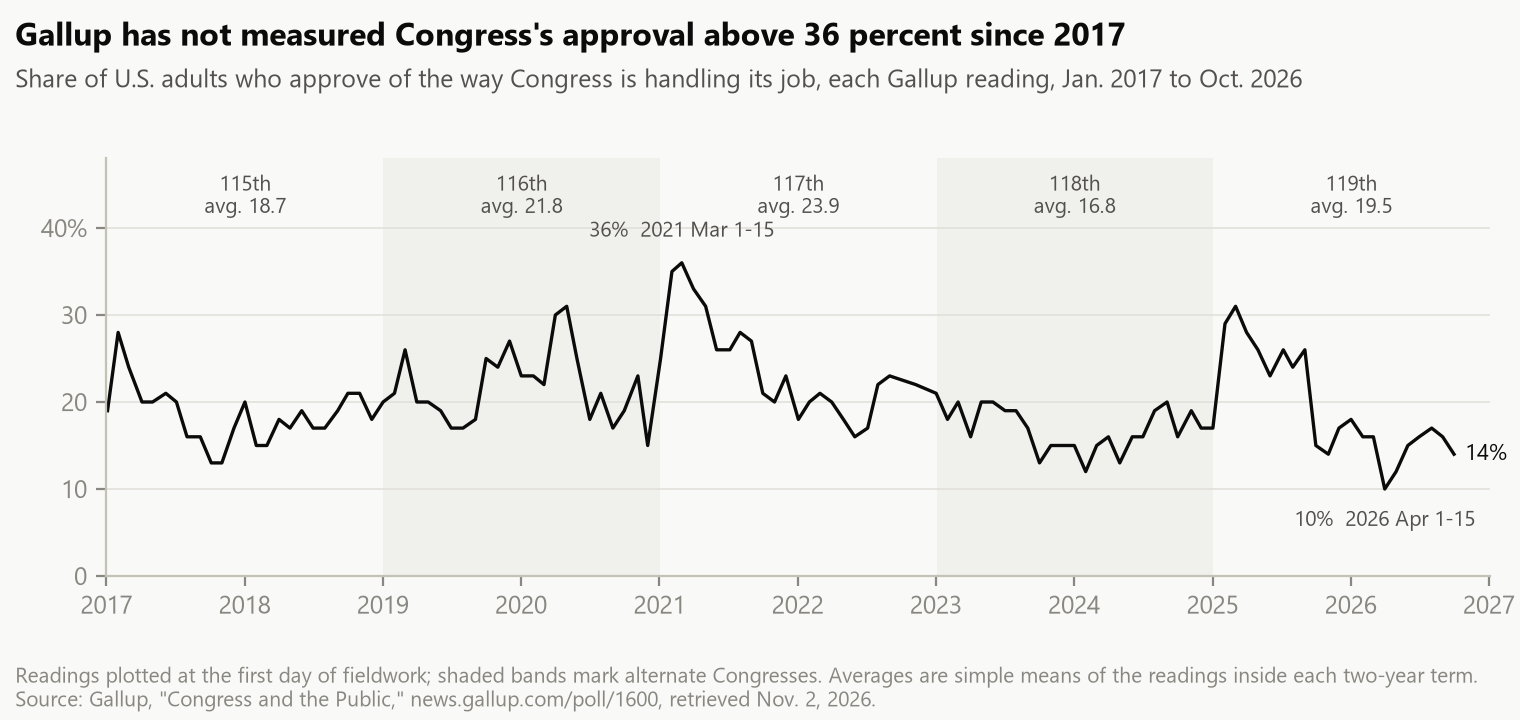
Gallup took 117 readings of congressional approval between January 2017 and October 2026. The mean inside each two-year term ran from 16.8 percent in the 118th Congress to 23.9 percent in the 117th, and no reading in the period exceeded 36 percent. That high came in the first half of March 2021, two months into the 117th Congress. The 118th, the Congress that took 15 ballots to elect a speaker and later removed him, never drew more than 20 percent.
Gallup’s reading for Jan. 2 to 15, 2025, fielded across the changeover between Congresses, was 17 percent. Approval rose to 29 in February and 31 in March and stayed between 23 and 28 through September. On Sept. 30, 2025, a House-passed stopgap fell short of the 60 votes it needed in the Senate, 55 to 45, and a Democratic alternative failed 47 to 53; Gallup’s October reading, fielded from Oct. 1 to 16, in the first weeks of the shutdown that followed, was 15. The April 2026 reading of 10 was fielded during a lapse in appropriations for the Department of Homeland Security that began in mid-February, according to NPR and other accounts collected for this series. Gallup’s trend table does not break the figures down by party, and timing alone does not show that a shutdown moved the number.
What became law
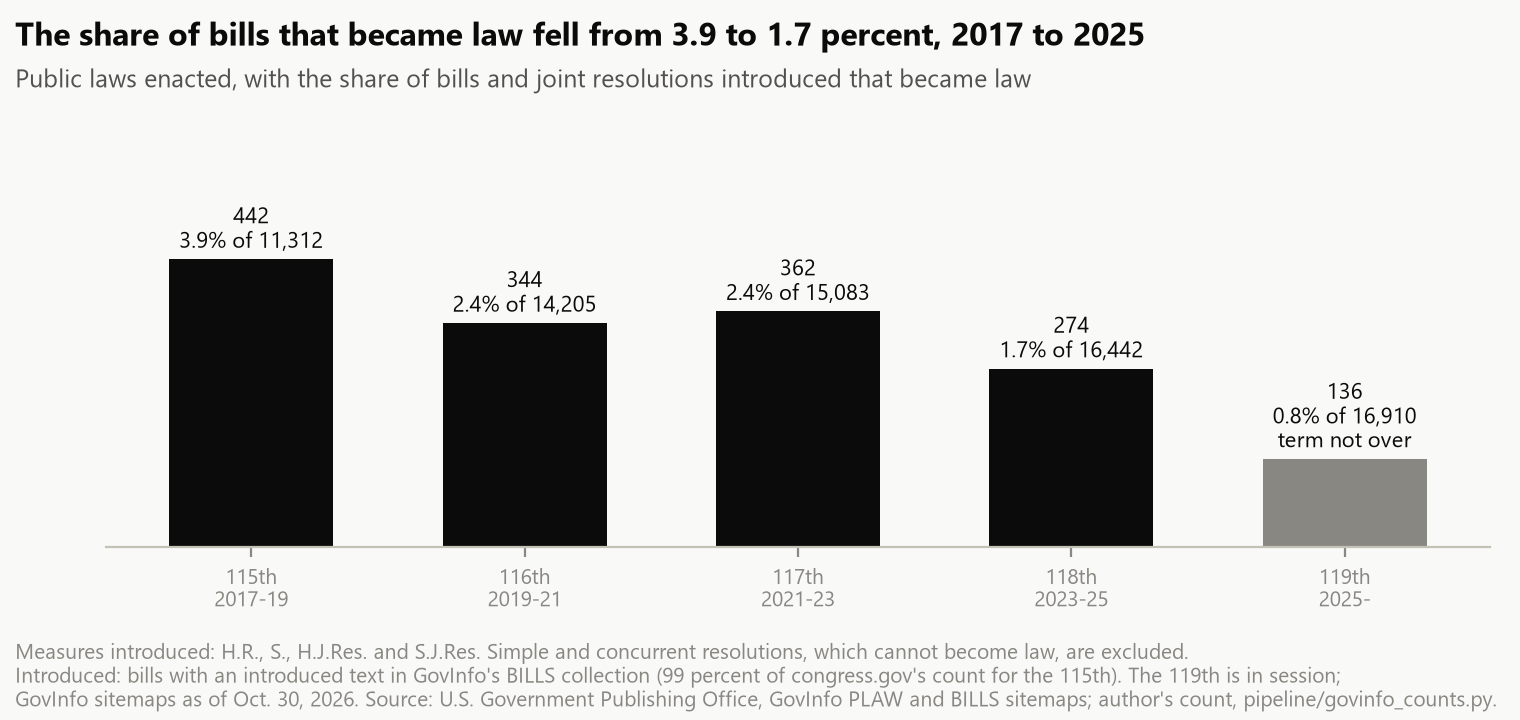
Members of the 115th Congress introduced 11,312 bills and joint resolutions, counting the introduced texts the Government Publishing Office printed, and 442 of them became public law, 3.9 percent. Each Congress since has introduced more: 14,205 in the 116th, 15,083 in the 117th, 16,442 in the 118th, and 16,910 in the 119th through late October 2026, already more than any full Congress in the period. Public laws numbered 344 in the 116th, 362 in the 117th and 274 in the 118th, when the share enacted reached 1.7 percent. By late October 2026 the Government Publishing Office had published 136 public laws from the 119th, with two months of its term left. A count of laws weighs a renamed post office the same as a tax overhaul, and an omnibus spending bill that carries dozens of measures counts once.
The Center for Effective Lawmaking at the University of Virginia and Vanderbilt University sorts the bills that become law, as its member-by-member records follow them (414 of the 442 public laws of the 115th, and all 274 of the 118th), into commemorative measures (the renamed post office, the coin, the commemorative week), substantive measures, and a smaller set it codes as substantive and significant. Its files end with the 118th Congress. By its count, the 115th enacted 304 bills that were more than commemorative; the 116th, 246; the 117th, 266; and the 118th, 189. The center’s count of significant laws went from 14 in the 116th to 40 in the 117th and 49 in the 118th, and the center widened its test for significance at the 117th, adding Project Vote Smart key votes and CQ House fact sheets to the CQ coverage it used before, so the rise and the change in method cannot be separated.
Five of the period’s laws went through budget reconciliation, which needs only a Senate majority, and none drew a vote from the minority party in either chamber. The Tax Cuts and Jobs Act passed the Senate 51 to 48 on Dec. 20, 2017, with no Democratic votes, and the House 224 to 201, with 12 Republicans opposed. The American Rescue Plan passed the Senate 50 to 49 in March 2021 and the House 220 to 211, with one Democrat opposed. The Inflation Reduction Act tied 50 to 50 in the Senate on Aug. 7, 2022, and Harris cast the deciding vote; the House passed it 220 to 207 with every Republican who voted opposed. The One Big Beautiful Bill Act tied 50 to 50 on July 1, 2025, with three Republicans voting no, and Vice President JD Vance broke the tie; the House passed it 218 to 214 on July 3. In June 2026 Republicans used the process a second time in the 119th Congress, passing the Secure America Act, which funds immigration enforcement, 52 to 47 in the Senate and 214 to 212 in the House, again with no Democratic votes.
The CARES Act, the infrastructure law, the 2023 debt-limit law and the 2024 Ukraine aid passed with votes from both parties. The Senate passed the CARES Act 96 to 0 in March 2020. The infrastructure law passed the Senate 69 to 30 in August 2021 with 19 Republican votes and the House 228 to 206 in November, with 13 Republicans in favor and six Democrats opposed. The Fiscal Responsibility Act, the May 2023 debt-limit agreement between Biden and Speaker Kevin McCarthy, passed the House 314 to 117 with 149 Republicans and 165 Democrats in favor. In April 2024 the House passed aid to Ukraine 311 to 112; 101 Republicans voted for it and 112 against, and all 210 Democrats who voted were in favor.
The votes
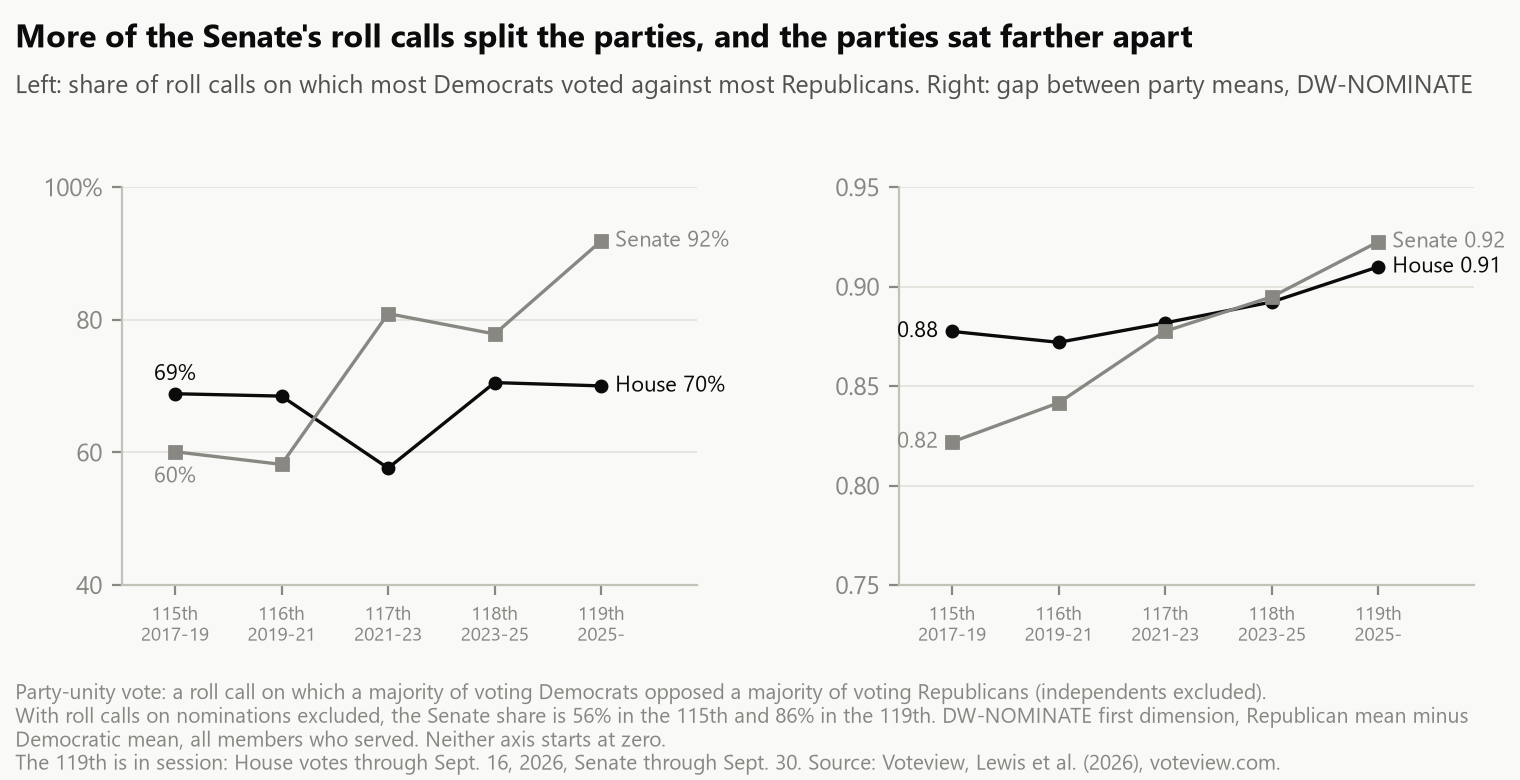
A party-unity vote, in Congressional Quarterly’s definition, is a roll call on which most voting Democrats oppose most voting Republicans. In the House the share held near seven in 10 for most of the period: 69 percent of roll calls in the 115th, 68 in the 116th, 58 in the 117th, 71 in the 118th, and 70 in the 119th through mid-September 2026. In the Senate it went from 60 percent in the 115th to 92 percent in the 119th, through Sept. 30, 2026, when 841 of 915 roll calls split the parties.
Part of the Senate’s increase comes from its calendar. Nominations took 475 of the 119th’s 915 Senate roll calls, counting the votes on resolutions to confirm lists of nominees together, and confirmation votes split the parties more often than they did in 2017. With nominations set aside, the share of the Senate’s legislative roll calls that split the parties went from 56 percent in the 115th to 86 percent in the 119th.
Voteview’s DW-NOMINATE scores place each member on a left-right scale from the member’s whole voting career. The distance between the Republican and Democratic means in the Senate grew in each Congress, from 0.82 in the 115th to 0.92 in the 119th; in the House it went from 0.88 to 0.91, dipping in the 116th. Because each member carries one score for a whole career, the change between Congresses comes from who held the seats. The scores are estimated from all votes cast through September 2026 and will shift as votes are added.
The floor speeches
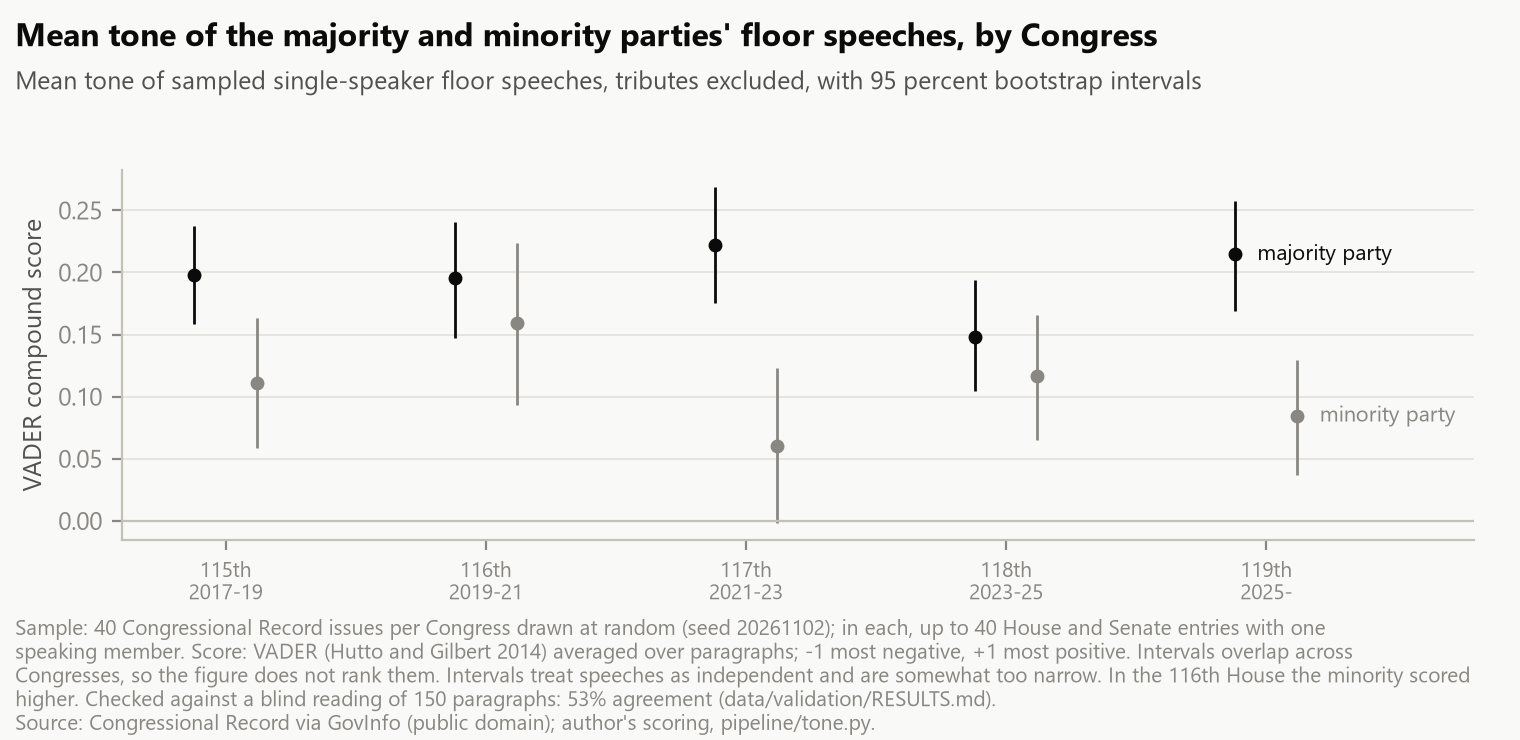
The Congressional Record prints what members say on the floor. A sample of it, 40 daily issues drawn at random from each Congress and up to 40 single-speaker entries from each issue, yielded 2,571 speeches once adjournments, amendment text and other housekeeping were removed; 24, 20, 21, 28 and 28 of the sampled issues, Congress by Congress, contained such speeches. Of the 2,571, 1,490 carried titles that did not mark them as tributes to constituents, teams, retirees or the dead. Each paragraph was scored with VADER, a published dictionary-based measure of tone, on a scale from -1 to +1, and each speech took the mean of its paragraphs.
In each of the five Congresses the minority party’s non-tribute speeches scored lower on average than the majority’s: 0.11 against 0.20 in the 115th, 0.16 against 0.20 in the 116th, 0.06 against 0.22 in the 117th, 0.12 against 0.15 in the 118th, and 0.08 against 0.21 in the 119th. The 95 percent intervals around the two means separate in the 117th and 119th and overlap in the other three, and they are somewhat too narrow because speeches by one member on one day are treated as independent. In the 115th, 117th and 119th the minority in both chambers was also the party out of the White House. Split into 10 chamber-and-Congress groups, the president’s party scored higher in all 10 and the majority party in eight. The two exceptions are the House in the 116th, where the Republican minority scored 0.21 and the Democratic majority 0.13, and the House in the 118th, where the Democratic minority and Republican majority scored 0.094 and 0.092; they are the only groups in which the chamber’s majority was not the president’s party. Each group holds 38 to 128 speeches.
To check the scorer, 150 paragraphs were labeled negative, neutral or positive by a reader who saw no score, speaker, party or date; the reader was a language model run apart from the scoring, and no human coders were used. VADER’s label matched the reader’s on 53 percent of paragraphs, and it scored 20 of the 55 paragraphs the reader called negative as positive. The direction of the party difference held in the blind reading: the reader labeled 56 percent of the minority’s paragraphs negative and 19 percent of the majority’s. Agreement at that level supports the direction of a difference between groups of speeches more than its size, and it supports no comparison between Congresses.
The fights and the coverage
115th Congress, 2017 to 2019. In May 2017, after the House passed the American Health Care Act 217 to 213, The Hill reported Sen. John Cornyn’s forecast that the Senate would pass a health bill that year. On July 28 the Senate rejected the last repeal measure 49 to 51, with three Republicans voting no, and Roll Call reported that John McCain’s vote had derailed the effort. The Congress ended with a funding lapse that began Dec. 22, 2018, over the president’s demand for border-wall money; Roll Call reported that Trump expected it to last a “very long time.”
116th Congress, 2019 to 2021. The lapse ran into a Democratic House and ended Jan. 25, 2019, after 35 days by the count in Axios’s headline, with a three-week stopgap and no wall money. Roll Call treated the reopening as a truce and named no winner; Axios headlined that the shutdown ended with “$0” for the wall. In December 2019 the House impeached Trump on two articles, the first 230 to 197.
117th Congress, 2021 to 2023. A week after the Capitol riot, the House impeached Trump a second time, 232 to 197, with 10 Republicans in favor. In November 2021 the House passed the infrastructure bill after progressive Democrats dropped their demand for a same-day vote on the larger Build Back Better bill, and in December Sen. Joe Manchin of West Virginia said he would not support that bill; Roll Call reported that his refusal effectively ended it in a 50-50 Senate. In mid-July 2022 Roll Call and Axios reported that Manchin had ruled out the bill’s climate and tax provisions. Thirteen days later he and Majority Leader Chuck Schumer announced the agreement that became the Inflation Reduction Act, which passed both chambers within three weeks.
118th Congress, 2023 to 2025. McCarthy won the speakership on the 15th ballot, 216 votes to Hakeem Jeffries’ 212, after agreeing, as The Hill and Roll Call reported, that a single member could force a vote to remove him. In September 2023 Axios headlined a piece on how Democrats could save him. On Oct. 2, as Rep. Matt Gaetz moved to remove him, Punchbowl News reported that McCarthy’s survival was uncertain and that Gaetz’s effort was likely to fail. The next day the House removed McCarthy 216 to 210; all 208 Democrats who voted and eight Republicans voted yes. Mike Johnson was elected speaker on Oct. 25, 220 to 209. The Senate passed a foreign-aid bill for Ukraine, Israel and Taiwan in February 2024. Johnson did not bring it to the House floor; in April he split it into four House bills, which passed April 20, and Punchbowl wrote that the vote could strengthen his speakership or threaten it. On May 8, 2024, 163 Democrats and 196 Republicans voted to table a motion to remove him.
119th Congress, 2025 to the present. On July 1, 2025, Axios reported that “well over 20” House Republicans were threatening to oppose the reconciliation bill; two voted against it on July 3, and it passed 218 to 214. After the Senate votes of Sept. 30, the government shut down. On Nov. 6 Axios reported Democrats pushing to prolong the shutdown after their wins in that week’s elections. On Nov. 10 the Senate passed a stopgap 60 to 40, with seven Democrats and one independent in favor; Axios reported that those Democrats had accepted the deal without a guarantee on the Affordable Care Act tax credits they had sought. The House cleared the stopgap 222 to 209 on Nov. 12, ending what Roll Call reported was the longest government shutdown on record. Punchbowl reported that Schumer’s hold on his post was secure “for now.”
In 2026 the Department of Homeland Security went without appropriations from mid-February until April 30, when, according to NPR, the House passed a bill funding most of it but not Immigration and Customs Enforcement or parts of Customs and Border Protection. Republicans funded those agencies through the Secure America Act, which Trump signed June 10, according to The Hill. After the war with Iran began on Feb. 28, by Roll Call’s account, the House held six votes on concurrent resolutions directing the president to remove U.S. forces from hostilities with Iran; three failed, by seven votes, by one vote and on a 212-212 tie, and three passed, the last 220 to 204 on Sept. 15. In the Senate after Feb. 28, 10 motions to discharge Iran war-powers resolutions from committee failed; one succeeded, and the Senate then voted 47 to 50 against taking up the resolution. The Senate adopted one House resolution 50 to 48 on June 23 and rejected another 49 to 50 on Sept. 24. On Oct. 15 Punchbowl reported that House Republicans privately feared heavy losses on Nov. 3.
The calendar after the vote
On Sept. 1 the House cleared, 370 to 48, a stopgap the Senate had passed 90 to 6 in August. Roll Call reported that it funds the government through Dec. 11, five weeks after Election Day and 23 days before the 119th Congress ends. The House that votes on what comes next is the one elected in November 2024, 220 Republicans and 215 Democrats at the count, with the winners of special elections since in the seats of members who died or resigned.
Data
- congress_table.csv · CSV · 1.5 KB · SHA-256
47e88c32704c96ddfd90d36308cd0168c9af6de07f744d45ff8c77ad6bc47951 - gallup_approval.csv · CSV · 13.6 KB · SHA-256
6653233fb0ae79db20e233c38882cabb9a466658e8af7fe2c51beb7d27727aa1 - govinfo_counts.csv · CSV · 0.5 KB · SHA-256
b45de485c2c508f5be28fc7cf47c8ce4c17cf279368e5771a973d2ff82c1f40d - rollcall_party.csv · CSV · 0.7 KB · SHA-256
63f0d964adc89bbff987c4395e4256a4d0e4b04386946a305725f68b41b3cef3 - polarization.csv · CSV · 0.7 KB · SHA-256
4d9ff47177d572df580cbebb8ab2d184063e721eacaf3ab217f40095e98eeb6f - key_votes.csv · CSV · 9.7 KB · SHA-256
dcdbe8371837bc018a49418b723e7441d46d8e58ab330bf10f2c96e035aeae16 - war_powers_votes_119.csv · CSV · 7.7 KB · SHA-256
84b3bdbaedfe43ca1e37e4e84d94022534d0f6526005127f1461f568bbaa5973 - tone_by_congress.csv · CSV · 1.5 KB · SHA-256
b6da71b76f3683b36e06ee77fb657e203e00dc8db0ebc38b3e36765ca52be99a - tone_by_chamber.csv · CSV · 0.7 KB · SHA-256
992165195fd3bd1708306b27b63c7a0248609d35be32cd36e5a86acad3a716b1 - About these files · Markdown · 1.6 KB · SHA-256
43929b12ae77696d45f3aa14470b45a3af1fbb38ee9fac4f23816ffe62679e43
Notes and sources
Linked file names can be downloaded from the Data list above. Other file names refer to the project’s working files, which are not yet public; the code is available from the author on request.
The data come from Voteview’s roll-call record (Lewis et al., 2026), Gallup’s “Congress and the Public” trend table, the Government Publishing Office’s GovInfo sitemaps, the Center for Effective Lawmaking, the Congressional Record via GovInfo, and the House and Senate historians. Figures from those sources are generated by the pipeline in ~/congress-history from the files named below; figures attributed to Roll Call, Axios, Punchbowl News, The Hill or NPR come from the reporting file, data/reporting/coverage.md, with URLs and access level, and were not recomputed. Sources, terms and gaps: data/MANIFEST.md. Definitions and the tone method: docs/METHODS.md. Independent reviews: draft 1 (134 figures and chart labels checked, six wrong) in docs/REVIEW-five-congresses.md; draft 2 (about 150 checked, one wrong, plus unfixed wording) in docs/REVIEW-five-congresses-draft2.md; all corrected here.
| Passage | Figures | File |
|---|---|---|
| Lede | 14 percent Oct. 1-19, 2026; 10 percent April 1-15, 2026; 401 readings since April 1974 (including two from 2009 with the month spelled out); 9 percent Nov. 7-10, 2013 | data/clean/gallup_approval.csv (from Gallup, news.gallup.com/poll/1600) |
| Margins | trifectas 115th, 117th, 119th; House seats won 241-194, 235-199, 222-212, 222-213, 220-215; NC-9 and NY-22 uncertified; 219 Republicans sworn in Jan. 3, 2025 (FL-1 vacant); Senate 52-48, 53-47, 50-50, 51-49, 53-47 | data/clean/congress_table.csv (House Historian; Senate Historical Office); Voteview H119 roll 1 (218 R for Johnson, 1 R for another candidate) |
| Approval | 117 readings 2017 to Oct. 2026; term means 18.7, 21.8, 23.9, 16.8, 19.5; high 36 (Mar. 1-15, 2021); 118th max 20; readings 17 (Jan. 2-15, 2025, assigned to the 118th by its start date), 29, 31, 23-28, 15, 10; Sept. 30, 2025 Senate votes 55-45 (H.R. 5371) and 47-53 (S. 2882); DHS lapse from mid-February (NPR; other accounts give Feb. 14) | gallup_approval.csv, congress_table.csv; Voteview S119 rolls 534 and 535; coverage.md 119th item 7 |
| Laws | introduced 11,312, 14,205, 15,083, 16,442, 16,910; public laws 442, 344, 362, 274, 136 (published by GovInfo through Oct. 30, 2026); 3.9, 2.4, 2.4, 1.7 percent; congress.gov check for the 115th: 11,421 measures and 442 laws; CEL coverage 414 of 442 (115th) and 274 of 274 (118th); CEL non-commemorative laws 304, 246, 266, 189; significant 14, 40, 49; method change at the 117th | data/clean/govinfo_counts.csv; congress_table.csv (columns cel_*), data/raw/cel/; thelawmakers.org/methodology |
| Key votes | TCJA 51-48, 224-201 (12 R no); ARP 50-49 and 220-211 (1 D no); IRA 50-50 and 220-207 (0 R yes, 4 R not voting); OBBBA 50-50 (3 R no) and 218-214; Secure America Act 52-47 and 214-212; CARES 96-0; IIJA 69-30 (19 R yes) and 228-206 (13 R yes, 6 D no); FRA 314-117 (149 R, 165 D yes); Ukraine 311-112 (101 R yes, 112 R no, 210 D yes) | data/clean/key_votes.csv (Voteview roll calls; each row carries its voteview.com URL) |
| Party votes | House 69, 68, 58, 71, 70 percent; Senate 60 and 92 percent; 841 of 915; 475 nomination roll calls (PN numbers plus 17 votes on en bloc resolutions); 56 and 86 percent excluding nominations | data/clean/rollcall_party.csv |
| Polarization | Senate 0.82 to 0.92; House 0.88 to 0.91, dip in 116th | data/clean/polarization.csv |
| Floor speeches | issues yielding speeches 24, 20, 21, 28, 28; 2,571 speeches, 1,490 non-tribute by title; chamber cells: president’s party higher in 10 of 10, majority in 8 of 10; 116th House R 0.2076, D 0.1343; 118th House D 0.0939, R 0.0923; 38 to 128 speeches a cell; minority and majority means 0.11/0.20, 0.16/0.20, 0.06/0.22, 0.12/0.15, 0.08/0.21; intervals separate in 117th and 119th; validation: 150 paragraphs, 53.3 percent agreement, kappa 0.33, 20 of 55 coded-negative scored positive, coded negative 55.6 percent minority and 19.2 percent majority | data/clean/tone_by_congress.csv; data/clean/tone_by_chamber.csv; data/clean/speech_tone.csv; data/validation/RESULTS.md |
| Coverage | Cornyn (The Hill, May 2017, snippet); Roll Call July 28, 2017; Roll Call Dec. 21-22, 2018; Roll Call and Axios Jan. 25, 2019 (35 days per Axios headline); Roll Call Dec. 19, 2021; Roll Call July 14, 2022, Axios July 15, 2022; McCarthy’s concession (The Hill and Roll Call, Jan. 7, 2023); Axios Sept. 12, 2023; Punchbowl Oct. 2, 2023; Punchbowl April 20 and May 8, 2024; Axios July 1, Nov. 6 and Nov. 10, 2025; Roll Call Nov. 12, 2025; Punchbowl Nov. 11, 2025; NPR April 30, 2026 (search summary); The Hill on the June 10 signing (snippet); Roll Call on Feb. 28; Punchbowl Oct. 15, 2026 | data/reporting/coverage.md and coverage_sources.csv (URL, author, date, access level) |
| Tallies in the forecasts section | AHCA 217-213; skinny repeal 49-51 (3 R no); impeachment 230-197 and 232-197 (10 R yes); speaker 216-212; vacate 216-210 (208 D, 8 R); Johnson 220-209; May 8, 2024 tabling 359-43 (163 D, 196 R yes); stopgap 60-40 (7 D, 1 I) and 222-209; H.R. 6500 90-6 and 370-48 | key_votes.csv |
| Iran war-powers votes | House: 3 failed (212-219, 213-214, 212-212), 3 passed (215-208, 214-208, 220-204 on Sept. 15); Senate after Feb. 28, 2026: 10 discharge motions rejected, 1 agreed (S.J.Res. 185, May 19) then motion to proceed rejected 47-50, H.Con.Res. 86 adopted 50-48, H.Con.Res. 89 rejected 49-50 (an 11th rejected discharge motion, S.J.Res. 59, came on June 27, 2025) | data/clean/war_powers_votes_119.csv (votes whose text names Iran) |
Not yet done: congress.gov counts for the 116th to 119th Congresses (the API’s demo key ran out; GovInfo’s counts are used and match congress.gov’s for the 115th within 1 percent); Politico’s Playbook coverage, which the research tools could not reach; the New York Times, Washington Post and Reuters congressional desks; full-text reads of the items held only as search snippets; Gallup’s partisan breakdowns; anything after the Nov. 3 vote.
Changelog
- Published.
Hesitation Media sends new records to the newsletter first. Subscribe on Substack.