Analysis
The confirmation machine: how the Senate changed the rules for nominees
The 2017, 2019 and 2025 rule changes, contested confirmation votes, judges confirmed by Congress, Supreme Court seats and Cabinet tie-breaks, 2017 to 2026.
On Sept. 18, 2025, the Senate confirmed 48 of President Donald Trump’s nominees with one roll call. Voteview’s record of the vote lists Peter Lamelas, nominated as ambassador to Argentina, first among them, followed by ambassadors to Sweden, Greece and Switzerland, a deputy trade representative and 43 others, and it passed 51 to 47, with every Republican who voted in favor and every Democrat who voted opposed. A week earlier, on Sept. 11, Republicans had voted 53 to 45 to overrule the chair and set a precedent that lets a simple majority end debate on a resolution authorizing the Senate to consider a list of nominations together; on Sept. 17 they overruled the chair a second time, 52 to 47, on a point of order raised on the first list itself, which Voteview’s record does not describe further. By Aug. 7, 2026, the Senate had confirmed five such lists, 375 nominations in all by the count in the senate.gov roll-call records.
Setting that procedure was the third time since 2017, after April 2017 and April 2019, that a Senate majority changed by simple-majority vote how nominations move.
The rule changes
April 2017. Democrats had enough votes to block cloture on Neil Gorsuch’s nomination to the Supreme Court under the rule then in force; 44 Democrats and independents voted against cloture on April 6. That day, Majority Leader Mitch McConnell raised a point of order that cloture on a Supreme Court nomination needs only a simple majority, and the Senate overruled the chair 52 to 48, every Republican on one side and every Democrat and independent on the other. Roll Call reported the same day that the legislative filibuster could come under the same pressure. Gorsuch was confirmed on April 7, 54 to 45, with three Democratic votes.
April 2019. Republicans failed to get 60 votes for a resolution cutting the debate allowed after cloture. On April 3, McConnell made the cut by precedent instead, in two votes: the Senate voted 51 to 48 to overrule the chair on the nomination of Jeffrey Kessler to be an assistant secretary of commerce, and 51 to 48 again on the nomination of Roy Altman to a federal district court in Florida. Most sub-Cabinet nominees and district judges now get two hours of debate after cloture, down from as many as 30. Two Republicans, Susan Collins and Mike Lee, voted with the Democrats. Roll Call reported that observers feared Cabinet, Supreme Court and appeals-court nominees could be next. In Voteview’s record through Sept. 30, 2026, the Senate has not overruled the chair again on debate time for those nominees or on cloture for legislation.
September 2025. Majority Leader John Thune said that by early September 2025 Democrats had allowed none of Trump’s civilian nominees through by unanimous consent or voice vote. Talks on a package of nominees collapsed on Aug. 2, and Roll Call reported that day that the threat to change the rules appeared to have been set aside. On Sept. 11 Thune’s resolution failed cloture 52 to 47, and Republicans then voted 53 to 45 to overrule the chair. The new procedure covers executive-branch nominees who carry two hours of post-cloture debate. It does not reach Cabinet secretaries or judges of the federal courts created under Article III of the Constitution, though 12 judges of the District of Columbia’s local courts were confirmed in the lists. A Republican senator can have a name removed from a list; the minority cannot.
The five lists confirmed 48 nominations on Sept. 18, 2025, 107 on Oct. 7, 97 on Dec. 18, 49 on May 18, 2026, and 74 on Aug. 7. No Democrat voted for any of them. On Sept. 8, 2025, Thune said, according to Roll Call, that clearing roughly 600 pending votes on nominations by the end of the year would exceed what the Senate had done all year. In December, Roll Call reported, citing Thune’s office, that 417 civilian nominees had been confirmed in 2025 and that the backlog was essentially cleared.
The votes
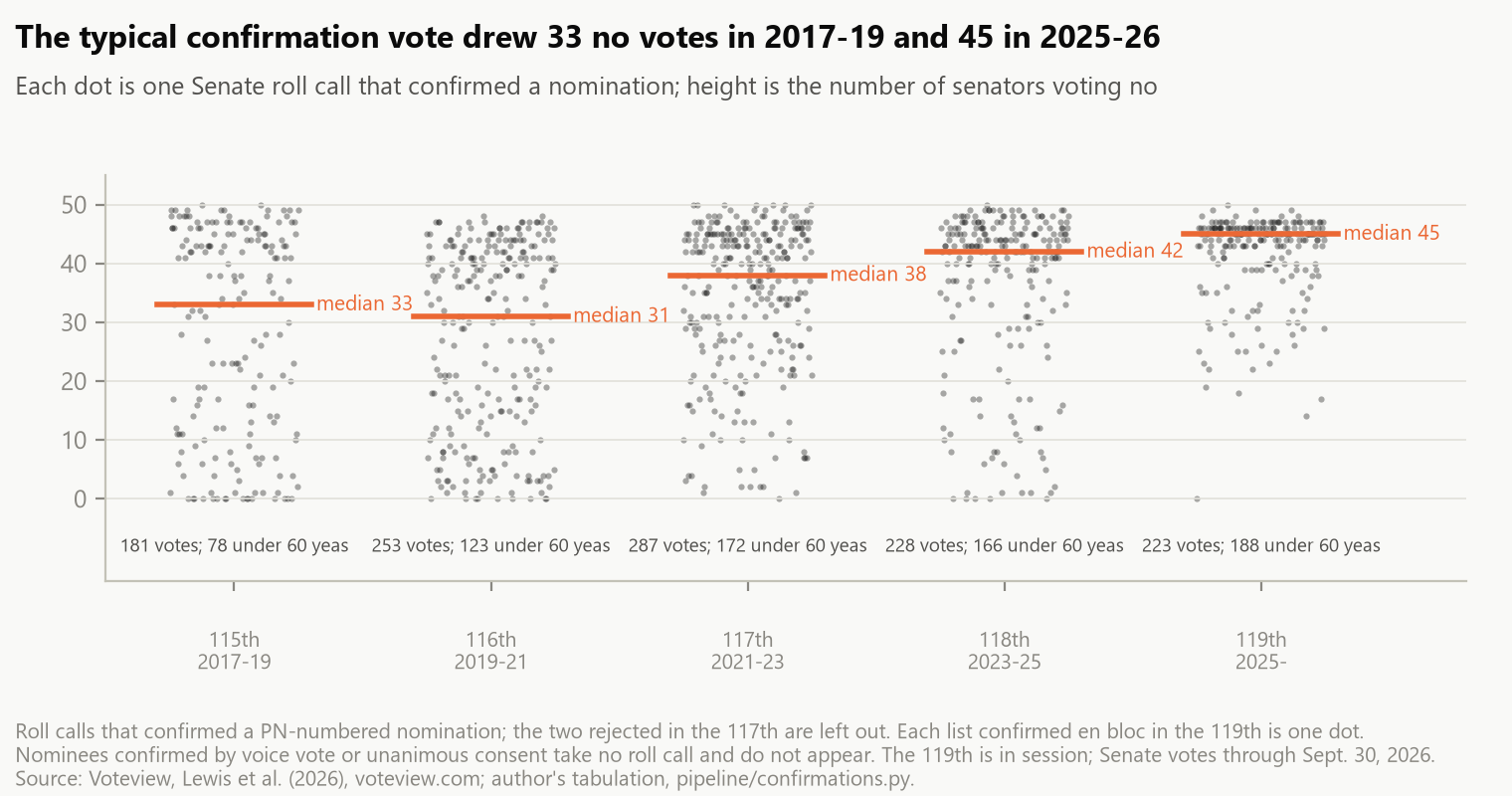
The median Senate roll call to confirm a nomination drew 33 no votes in the 115th Congress and 45 in the 119th, through Sept. 30, 2026; between them it was 31, 38 and 42. In the 115th, 16 of 181 confirmation roll calls were unanimous. In the 119th one of 223 was: Marco Rubio’s confirmation as secretary of state, 99 to 0, on Inauguration Day. Confirmation roll calls won with fewer than 60 votes numbered 78 in the 115th, 123 in the 116th, 172 in the 117th, 166 in the 118th and 188 in the 119th.
The count of confirmation roll calls understates the volume, because a list of 107 nominees takes one roll call and a nominee confirmed by voice vote or unanimous consent takes none. The Senate’s Résumé of Congressional Activity counts civilian nominations confirmed in each Congress: 714 in the 115th, 518 in the 116th, 818 in the 117th and 358 in the 118th. The 119th’s Résumé is not complete.
The judges
The Federal Judicial Center records how the Senate confirmed every federal judge. In the 115th Congress, 26 of the 85 judges of the Article III courts were confirmed by voice vote, and the 27 district judges confirmed by roll call drew a median of 10 no votes. In the 117th, district judges confirmed by roll call drew a median of 43 no votes. In the 119th, through Sept. 23, 2026, all 56 Article III judges were confirmed by roll call, and the district judges drew a median of 45 no votes. Nominees to the courts of appeals drew a median of 43 to 46 no votes in every one of the five Congresses.
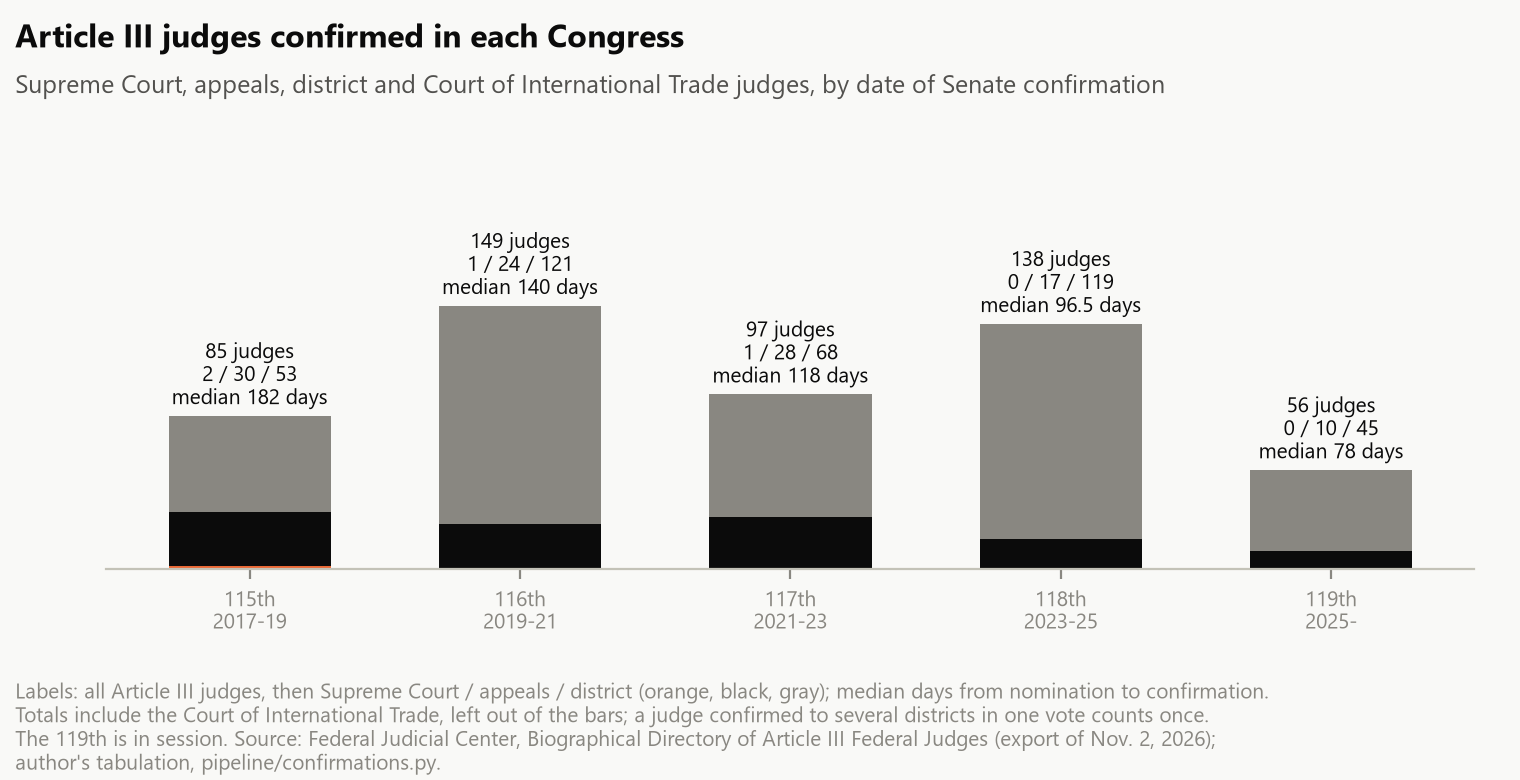
The Senate confirmed 85 Article III judges in the 115th Congress, 30 of them to the courts of appeals and two to the Supreme Court. It confirmed 149 in the 116th, 97 in the 117th, 138 in the 118th, and 56 in the 119th through Sept. 23, 2026, 10 of them to the appeals courts. The median time from nomination to confirmation was 182 days in the 115th, 140 in the 116th, 118 in the 117th, 96.5 in the 118th and 78 so far in the 119th; the last figure counts only judges already confirmed, so it will rise if nominees now pending take longer. Bloomberg Law reported in December 2025 that 49 judgeships were vacant and that few judges were retiring.
In January 2023, after President Joe Biden’s first two years, Russell Wheeler of the Brookings Institution wrote that Trump’s four-year record of judicial appointments seemed secure. The center’s records give Trump’s first term 234 Article III judges and Biden’s term 235, the same totals NBC News reported on Dec. 20, 2024, when the Senate confirmed Biden’s last. Trump’s first term placed more judges on the appeals courts, 54 to Biden’s 45.
The Supreme Court seats
Three justices were confirmed in Trump’s first term and one in Biden’s. Gorsuch was confirmed 54 to 45 in April 2017. Brett Kavanaugh was confirmed 50 to 48 on Oct. 6, 2018, after Christine Blasey Ford testified before the Senate Judiciary Committee on Sept. 27, 2018 that he had sexually assaulted her when they were in high school, which he denied in the same hearing, and after a one-week supplemental FBI background inquiry; Joe Manchin was the only Democrat in favor, and Lisa Murkowski voted present. Roll Call reported McConnell’s prediction that the fight would fade and Sen. Amy Klobuchar’s that voters would answer it at the next election.
Amy Coney Barrett was confirmed 52 to 48 on Oct. 26, 2020, eight days before the presidential election, with Collins the only Republican opposed. Ketanji Brown Jackson’s nomination tied 11 to 11 in the Judiciary Committee in April 2022, under the power-sharing agreement of the 50-50 Senate; the Senate discharged it 53 to 47 and confirmed her 53 to 47 three days later, with Collins, Murkowski and Mitt Romney in favor.
The research for this piece found no Supreme Court vacancy in the 119th Congress through Nov. 2, 2026. In July 2026 Punchbowl News reported Thune’s view that a vacancy would become his first priority and that a confirmation in the lame-duck session after the election was feasible.
The Cabinet
Twice in the period a vice president broke a tie to confirm a Cabinet secretary. Betsy DeVos was confirmed as education secretary 50 to 50, with Vice President Mike Pence’s vote, on Feb. 7, 2017; Collins and Murkowski voted no. Pete Hegseth was confirmed as defense secretary 50 to 50, with Vice President JD Vance’s vote, on Jan. 24, 2025; Collins, Murkowski and McConnell voted no. Roll Call reported that Hegseth’s confirmation broke with the custom of bipartisan votes for defense secretaries.
Turnover in 2026 sent a second round of Cabinet nominations to the Senate, and each went through its own cloture roll call and confirmation roll call. Todd Blanche was confirmed as attorney general 50 to 49 on Aug. 8, 2026, with Collins and Murkowski opposed.
What was said beforehand
After the 2017 change Roll Call raised the possibility that the legislative filibuster would come under the same pressure, and after the 2019 change it reported that observers feared appeals-court and Supreme Court nominees could be next; through September 2026, Voteview records no vote changing either. In November 2023 NBC News reported that Sen. Tommy Tuberville said his hold on military promotions, over a Pentagon policy on travel for abortions, would last until the policy or the law changed; on Dec. 5 Bloomberg reported that he had ended most of it. On Aug. 2, 2025, Roll Call reported that the threat to change the rules for nominations appeared to have been set aside, and Republicans changed them 40 days later.
After the vote
Punchbowl News reported in July 2026 that Thune wanted as many judges confirmed as possible before November, because votes in a lame-duck session are unreliable. The Senate that sits after Nov. 3 and until Jan. 3, 2027 is the one that opened the 119th Congress with 53 Republicans, and the precedents of September 2025 pass to whichever party holds the majority after that.
Data
- confirmations_by_congress.csv · CSV · 0.9 KB · SHA-256
c2d32d35c6e8310f36df425873f13f7e555080b68b04c65ae4407d431a8fec8b - nomination_rollcalls.csv · CSV · 550.2 KB · SHA-256
5d342b4a33660bdefe995517fffd32dc7750d6219083c872357f31dc406c514f - judges_confirmed.csv · CSV · 90.8 KB · SHA-256
c95aa5b884e993bfbc5e8b16d47643a3cec37ca10c01b0668db1be966c316aab - en_bloc_batches.csv · CSV · 0.7 KB · SHA-256
07c4f12de1cf15d34bf84a0b750470e6ce489d18856a72a21875e7bd7fb1fef5 - key_votes.csv · CSV · 9.7 KB · SHA-256
dcdbe8371837bc018a49418b723e7441d46d8e58ab330bf10f2c96e035aeae16 - About these files · Markdown · 1.6 KB · SHA-256
43929b12ae77696d45f3aa14470b45a3af1fbb38ee9fac4f23816ffe62679e43
Notes and sources
Linked file names can be downloaded from the Data list above. Other file names refer to the project’s working files, which are not yet public; the code is available from the author on request.
Roll-call tallies, party splits, medians and judge counts are generated by ~/congress-history/pipeline/confirmations.py and keyvotes.py from Voteview and the Federal Judicial Center. Figures attributed to Roll Call, NBC News, Punchbowl News, Bloomberg, Brookings and the Senate Résumé come from the reporting file, data/reporting/confirmations.md, with URLs, and were not recomputed. Sources, terms and gaps: data/MANIFEST.md. Independent reviews: draft 1 (67 figures checked, 8 wrong) in docs/REVIEW-confirmations.md; draft 2 (76 checked, 4 wrong) in docs/REVIEW-confirmations-draft2.md; all corrected here.
| Passage | Figures | File |
|---|---|---|
| Lede | Sept. 18, 2025, 51-47, 0 D yes; Lamelas first, then Sweden, Greece, Switzerland, deputy USTR; Sept. 11 precedent 53-45 (chair not sustained 45-53); Sept. 17 precedent 52-47 (roll 524, 47-52 on sustaining) | data/clean/key_votes.csv; data/clean/nomination_rollcalls.csv; Voteview S119 rolls 515, 524, 526 |
| Five lists | 48, 107, 97, 49, 74 = 375 nominations (senate.gov roll-call text); tallies 51-47, 51-47, 53-43, 46-43, 51-47; Voteview’s descriptions list 48, 107, 98, 49, 74 entries; 12 D.C. local-court judges (1, 0, 3, 0, 8) | confirmations.md item 16; data/clean/en_bloc_batches.csv; key_votes.csv |
| 2017 | 44 D and I against cloture (roll 105); 52-48; Gorsuch 54-45, 3 D yes | Voteview S115 roll 105; key_votes.csv |
| 2019 | 51-48 to overrule on Kessler (roll 59) and on Altman (roll 61); Collins and Lee | key_votes.csv (2 R yea on sustaining); names from confirmations.md item 5 |
| 2025 | Thune’s account of UC and voice votes by early September; Aug. 2 collapse; cloture 52-47 failed (roll 513); 53-45; 600 pending votes; 417 in 2025 | confirmations.md items 15 and 16; nomination_rollcalls.csv |
| Votes | median nays 33, 31, 38, 42, 45 (the 117th’s two rejected nominations, rolls 747 and 861, excluded); 16 of 181 and 1 of 223 unanimous; Rubio 99-0; under 60 yeas 78, 123, 172, 166, 188 | data/clean/confirmations_by_congress.csv; nomination_rollcalls.csv |
| Résumé | civilian confirmed 714, 518, 818, 358 | Senate Résumé PDFs via confirmations.md, “Authoritative counts” |
| Judges | 26 of 85 by voice (115th); 27 district roll calls, median 10; district medians 43 (117th), 45 (119th); appeals 43-46; totals 85, 149, 97, 138, 56; appeals 30 and 10; Supreme Court 2; median days 182, 140, 118, 96.5, 78; Trump first term 85+149 = 234, Biden 97+138 = 235 | confirmations_by_congress.csv; data/clean/judges_confirmed.csv (FJC export of Nov. 2, 2026; one row per judge per confirmation date) |
| Judge forecasts | Wheeler (Brookings, Jan. 30, 2023); NBC Dec. 20, 2024; Roll Call 54 vs 45 appeals; Bloomberg Law 49 vacancies (Dec. 23, 2025) | confirmations.md items 10, 13 and 18 |
| Supreme Court | Ford’s testimony and Kavanaugh’s denial, Senate Judiciary Committee hearing of Sept. 27, 2018 (public record); Kavanaugh 50-48, 1 present; Barrett 52-48, 1 R no; Jackson discharge 53-47 and confirmation 53-47, 3 R yes; committee tie 11-11 | key_votes.csv; confirmations.md items 3 and 9 |
| Cabinet | DeVos 50-50, 2 R no; Hegseth 50-50, 3 R no; Blanche cloture 50-49 and confirmation 50-49, 2 R no | key_votes.csv; nomination_rollcalls.csv |
| Forecasts | Roll Call April 6, 2017 and April 3, 2019; NBC Nov. 1, 2023; Bloomberg Dec. 5, 2023 (headline only); Roll Call Aug. 2, 2025 | confirmations.md items 2, 5, 11 and 15 |
Method notes: a confirmation roll call is a Senate roll call whose question is “On the Nomination” for a PN-numbered nomination; a list confirmed en bloc counts as one. Judges are appointments to Article III courts (Supreme Court, appeals, district, Court of International Trade) in the FJC directory, assigned to a Congress by confirmation date; a judge confirmed to more than one district in one vote counts once. Medians of no votes for judges cover only judges confirmed by roll call. The 119th Congress figures are partial: Senate votes through Sept. 30, 2026, judges through Sept. 23, 2026.
Not yet done: Politico, Reuters, AP and New York Times coverage (unreachable by the research tools); the Senate Historian’s pages; the 119th Congress Résumé; a primary-source check of the Tuberville account; what the Sept. 17, 2025 point of order decided.
Changelog
- Published.
Hesitation Media sends new records to the newsletter first. Subscribe on Substack.