Analysis
The culture of Georgia's swing counties
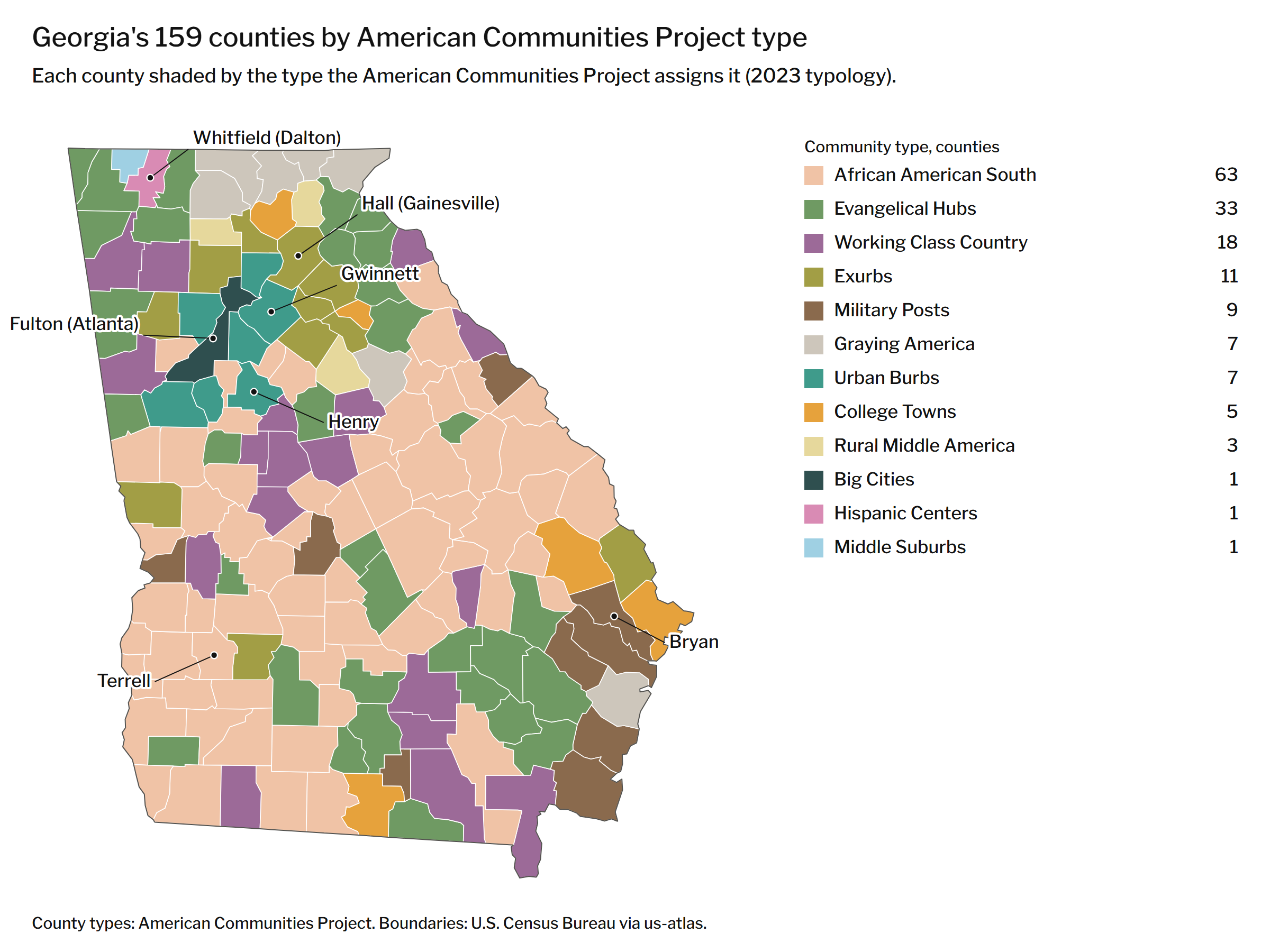
Metro Atlanta's 27 counties outside Fulton and DeKalb cast 40.8 percent of Georgia's 2022 vote and 61 percent of its 2018-to-2022 movement; Henry County moved most.
| Figure | Value |
|---|---|
| Henry County’s margin change minus the state’s, 2018 to 2022 | 14.1 points toward the Democrat |
| Metro Atlanta outside Fulton and DeKalb, share of the 2022 vote | 40.8 percent |
| Same 27 counties, share of the 2018-to-2022 movement | 61 percent |
| Black residents Henry added, 2020 to 2025 | More than 30,000 |
Between the 2018 and 2022 governor’s races, Henry County’s margin moved 14.1 points further toward the Democratic candidate than the state’s did, the largest shift of any Georgia county. Henry is one of 27 metro Atlanta counties outside Fulton and DeKalb, among them Cherokee and Forsyth to the north and Coweta and Spalding to the south.
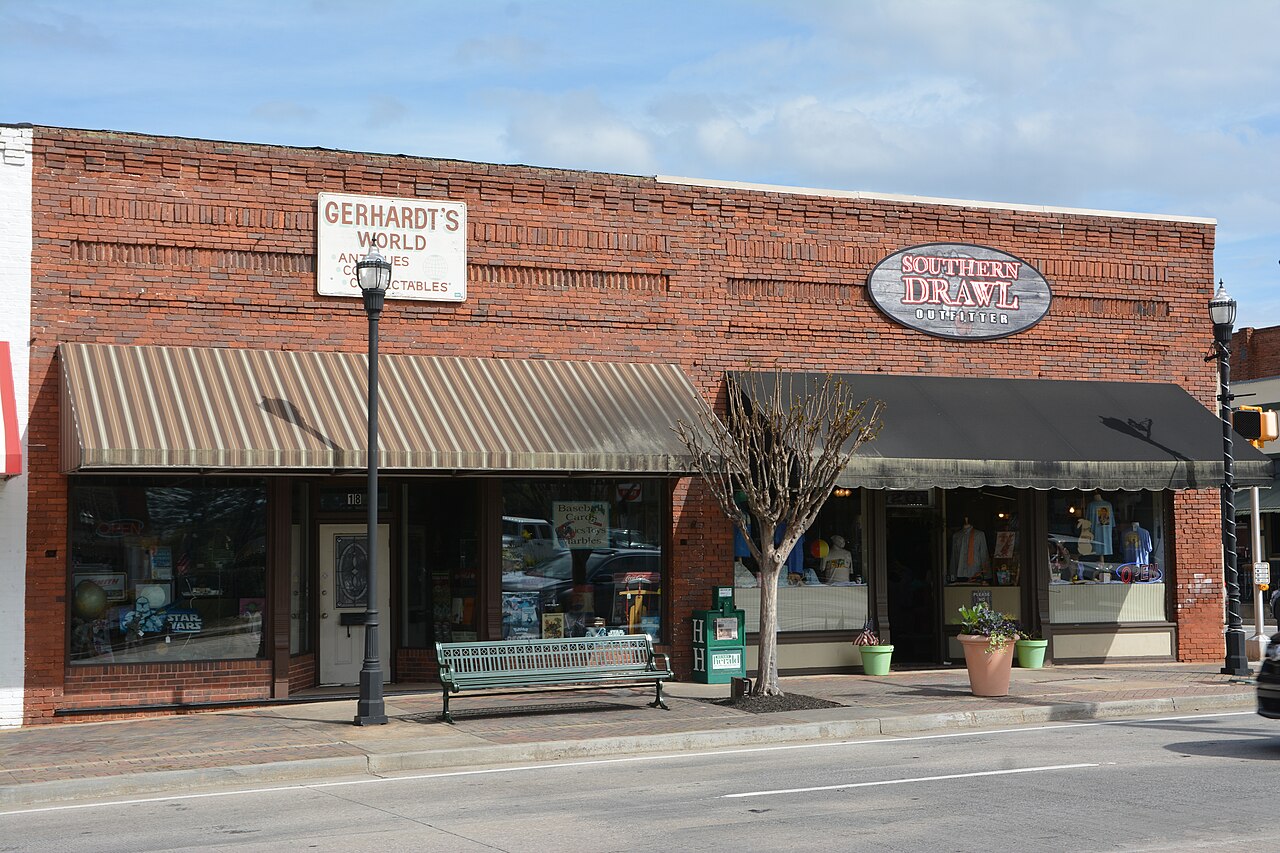
McDonough, Henry’s seat, was laid out on the site of an Indian trading post and incorporated in 1823, and Shingleroof Methodist Campground there has been a camp meeting site since 1830.
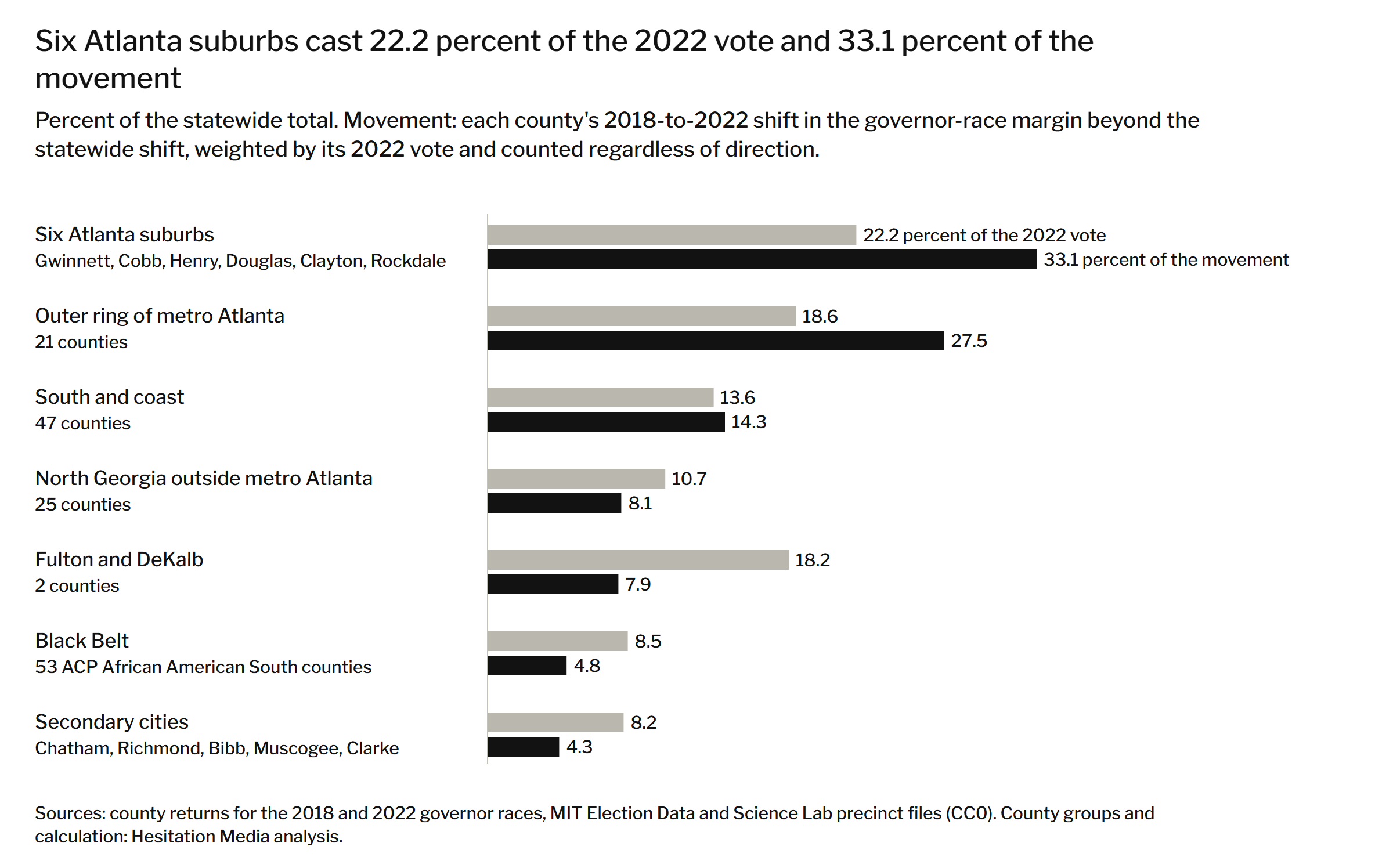
The 27 counties cast 40.8 percent of Georgia’s 2022 vote and carried 61 percent of its movement between the two governor’s races, each county measured against the statewide margin. Fulton and DeKalb cast 18.2 percent of the vote and carried 7.9 percent of the movement.
Henry County and McDonough
Henry cast 3.0 percent fewer ballots in 2022 than in 2018. Rockdale and Douglas had the next-largest shifts in Georgia, 13.1 and 10.5 points further toward the Democrat than the state’s. The American Communities Project classes Henry as an Urban Suburb and Clayton, Rockdale, Douglas and Newton as African American South.
Henry added more than 30,000 Black residents from 2020 to 2025, the largest increase statewide, the Atlanta Journal-Constitution reported.
| County | Population change, 2010 to 2020 | Black share of residents | Adults with a bachelor’s degree |
|---|---|---|---|
| Henry | +18.0% | 49.8% | 28.0% |
| Clayton | +14.7% | 68.7% | 21.3% |
| Rockdale | +9.8% | 57.1% | 29.1% |
| Douglas | +8.9% | 48.5% | 30.8% |
| Newton | +12.5% | 47.1% | 23.6% |
Sources: U.S. Census Bureau, 2010 and 2020 decennial counts and the 2019-2023 American Community Survey five-year profile. Georgia’s bachelor’s share is 34.2 percent.
Clayton, home to Hartsfield-Jackson, the state’s largest employer center, has gone from 91 percent white to more than 70 percent Black. Its ballots fell 8.8 percent from 2018 to 2022.
Rockdale was a mostly white farming community that diversified as metro Atlanta grew, Betsie Garner wrote in a 2017 University of Pennsylvania dissertation. She found that Black and white Christians there worshipped together and ran service projects aimed at racial reconciliation, and that the group drew scrutiny for “inhospitable or hostile” treatment of sexual, racial-ethnic and religious minorities.
Fulton and DeKalb
Fulton and DeKalb gave the Democratic candidate a net 348,297 votes in 2022, down from 405,717 in 2018, and DeKalb cast 4.6 percent fewer ballots than four years earlier. Against the state, the two counties moved 0.2 points toward the Republican.
Bachelor’s holders are 58.0 percent of Fulton’s adults, against 34.2 percent statewide.
The New Georgia Encyclopedia traces Atlanta’s Black middle class to its Black colleges, Atlanta University from 1865, Morehouse from 1867 and Spelman from 1881, and to “growing economic opportunities.” Metro Atlanta’s Black population more than doubled between 1990 and 2020 and topped two million, “second only to New York in urban concentration of African Americans,” the encyclopedia says.
The Atlanta Regional Commission reported in 2023 that nearly 80 percent of the young adults moving into Atlanta were Black.
Gwinnett and Buford Highway
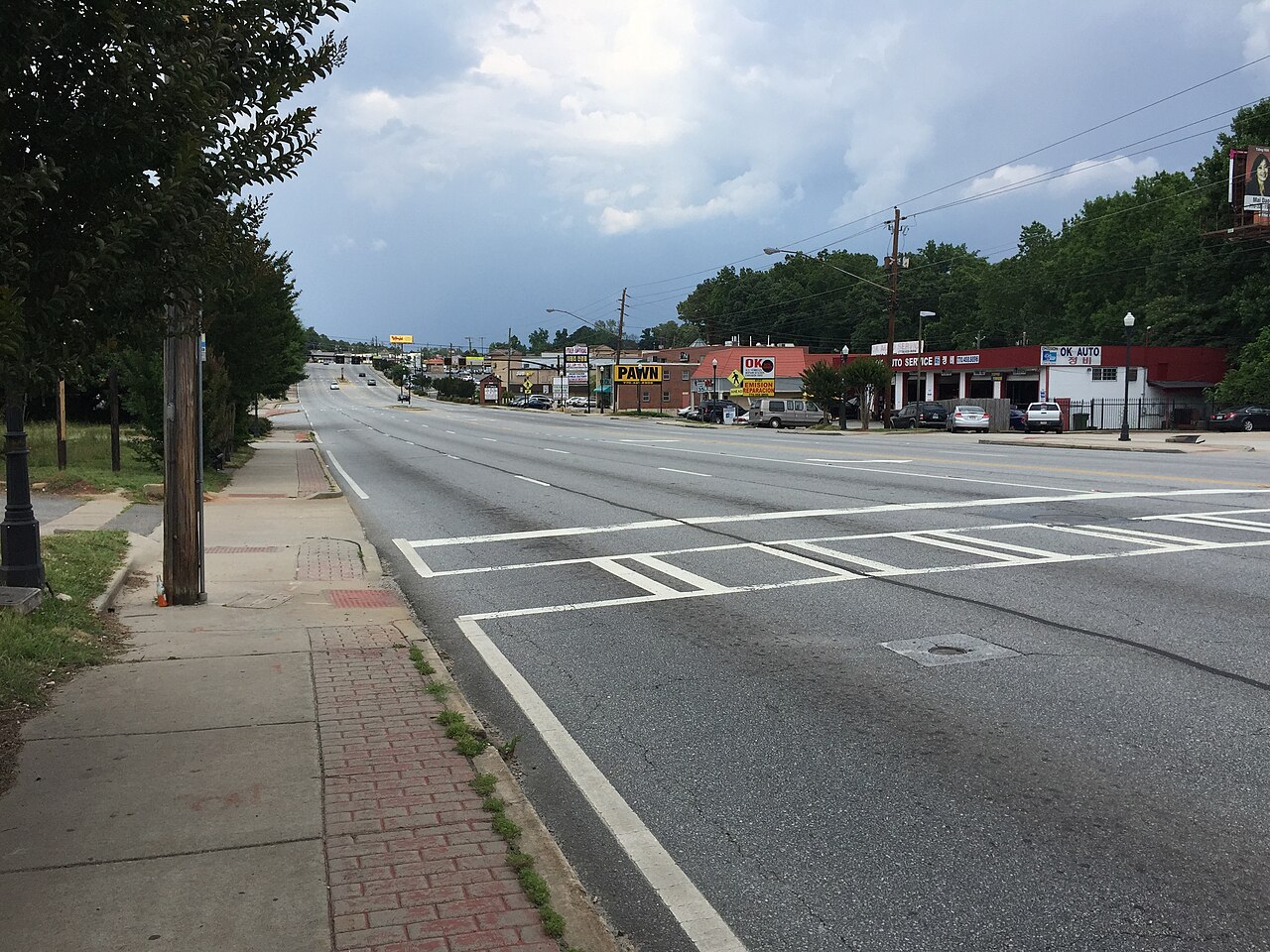
Gwinnett has passed through three phases, William Grady Holt wrote in 2010: small towns and farms from the 1820s to the 1960s; a suburban county from the 1970s to the 1990s, when rustbelt migrants and rural Southerners made it “upscale, white, upper middle class Republican”; then deteriorating older corridors and international migration, with the county majority-minority by 2009.
The Atlanta Regional Commission counted 42,360 Asian residents in Gwinnett in 2000 and 106,374 in 2019. Between 2020 and 2025 the county gained nearly 100,000 minority residents and lost nearly 35,000 non-Hispanic white ones, the AJC reported.
| Group | Share of residents |
|---|---|
| Gwinnett County, foreign-born | 27.4% |
| Gwinnett, Hispanic | 23.2% |
| Gwinnett, Black | 27.8% |
| Gwinnett, Asian | 12.8% |
| Norcross, Hispanic | 38.8% |
| Duluth, Asian | 23.4% |
Source: U.S. Census Bureau, 2019-2023 American Community Survey five-year profile, county and place tables.
AJ Kim, a planning scholar, found in 2024 that ICE enforcement near Buford Highway intensified under the first Trump administration.
The 2020 U.S. Religion Census counts more Catholics than Southern Baptists in Gwinnett and in Hall County; Southern Baptists lead in Whitfield and in Cherokee County, where they count 57,101 adherents.
| County | Catholic adherents | Southern Baptist adherents |
|---|---|---|
| Gwinnett | 107,918 | 73,648 |
| Hall | 65,020 in three congregations | 48,511 in 60 congregations |
| Whitfield | 20,365 in two congregations | 25,896 |
Source: 2020 U.S. Religion Census, as published by the Association of Religion Data Archives.
St. Andrew Kim, a Korean Catholic mission in Duluth, grew from 98 registered families in August 2011 to 228 by early 2013, the Georgia Bulletin reported. Our Lady of the Americas in Lilburn, an all-Spanish-speaking congregation, counted about 6,000 members when it left a Doraville warehouse in 2006.
The region’s press includes the AJC, which printed its last newspaper on Dec. 31, 2025, after 157 years; Mundo Hispanico, founded in 1979; and Korea Daily, which keeps an Atlanta bureau.
Forsyth, north of Gwinnett, grew 43.2 percent between 2010 and 2020. Nearly 90 percent of its growth since 2020 has been Asian, the AJC reported.
Gwinnett’s margin moved 7.1 points further toward the Democrat than the state’s between the 2016 and 2020 presidential races and 2.2 points further between the two governor’s races, and Cobb’s moved 1.1 points further between the governor’s races.
Dalton and north Georgia
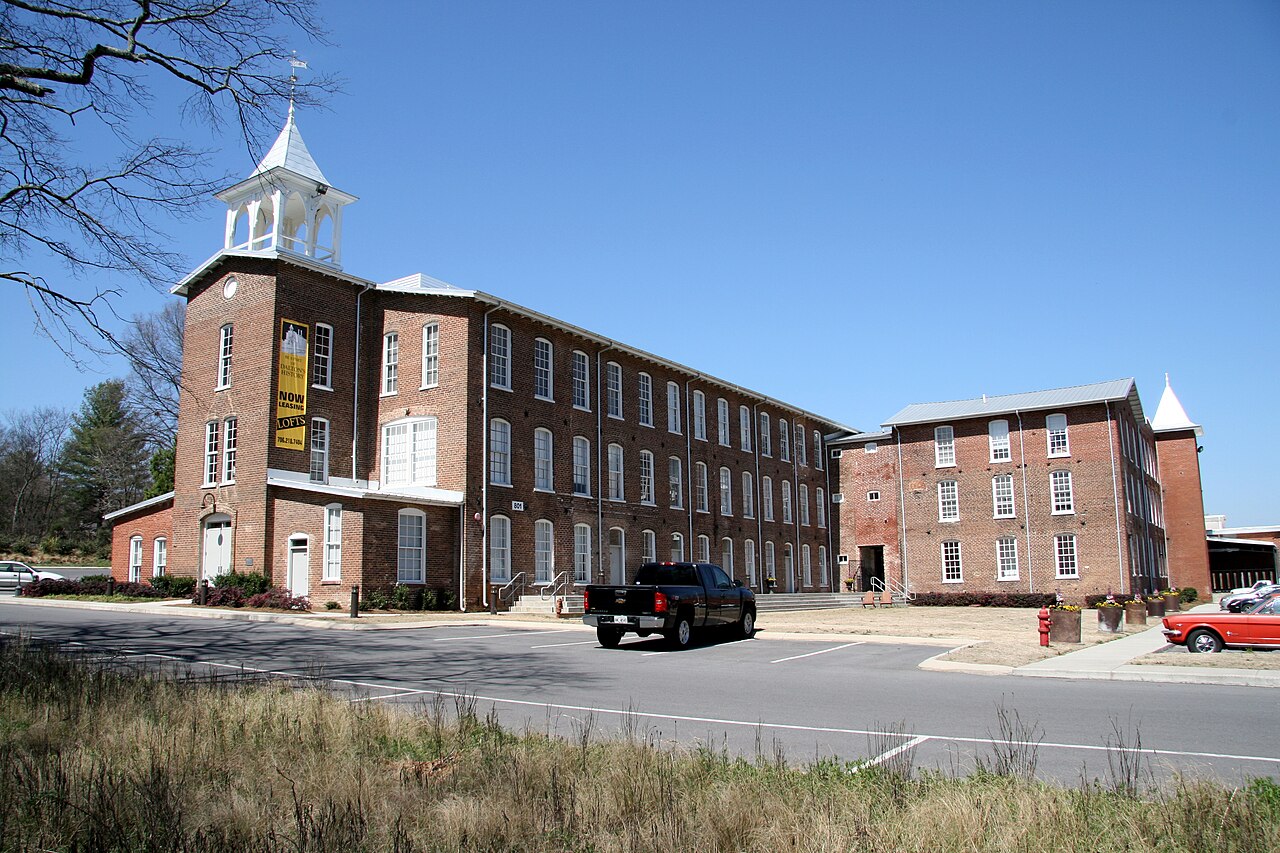
More than 80 percent of the tufted carpet made in America comes from within 100 miles of Dalton. Hispanic workers filled a mill labor shortage in the late 1980s and 1990s, and by 2000 more than 40 percent of Dalton’s residents were Latino. The 2019-2023 survey puts the city at 53.3 percent Hispanic.
Whitfield moved 4.0 points toward the Republican relative to the state between the governor’s races. Manufacturing employs 34.6 percent of its workers, against 10.2 percent statewide, and its population was flat between 2010 and 2020. ACP counts it as Georgia’s one Hispanic Center.
In Hall County poultry supplanted textiles, and Gainesville calls itself the Poultry Capital of the World. Northeast Georgia’s processing lines changed from a Black and white workforce to an almost exclusively Hispanic one by the turn of the century, with most of Hall’s Latino residents living in neighborhoods where poverty runs above 50 percent.
The 25 north Georgia counties outside the metro cast 7.9 percent more ballots in 2022 than in 2018, and their net Republican vote grew from 228,430 to 269,166. The American Communities Project puts five of them, the mountain counties Fannin, Gilmer, Union, Towns and Rabun, in its Graying America type.
Turnout in the January 2021 Senate runoffs, held between the two governor’s races, fell by about 310,000 voters across the 1,387 precincts Trump had won in November, Stephen Fowler of GPB News found. Seventeen counties saw turnout drop at least 10 percent, concentrated in heavily Republican northwest Georgia, with others in the northeast.
Bases and the coast
Fort Benning employs about 35,000 military and civilian personnel on 287 square miles of Chattahoochee and Muscogee counties. It became Fort Moore in May 2023 and Fort Benning again under a March 3, 2025, memorandum, now named for Cpl. Fred G. Benning.
ACP’s Military Posts type includes Houston, Liberty, Camden, Bryan and Columbia. Fort Stewart’s creation in 1940 took almost half of Liberty County and displaced more than 1,500 families. Between the governor’s races, Houston moved 4.5 points toward the Democrat against the state, and Columbia, northwest of Augusta, moved 4.8.
Savannah’s port handles nearly 10 percent of U.S. containerized cargo. Hyundai’s Metaplant in Bryan County had 1,232 employees, not counting Korean expatriates, at its March 2025 opening, and in September 2025, weeks after an immigration raid there, the AP reported Hyundai would spend $2.7 billion to raise capacity to 500,000 vehicles a year.
Terrell County and the rural Black Belt
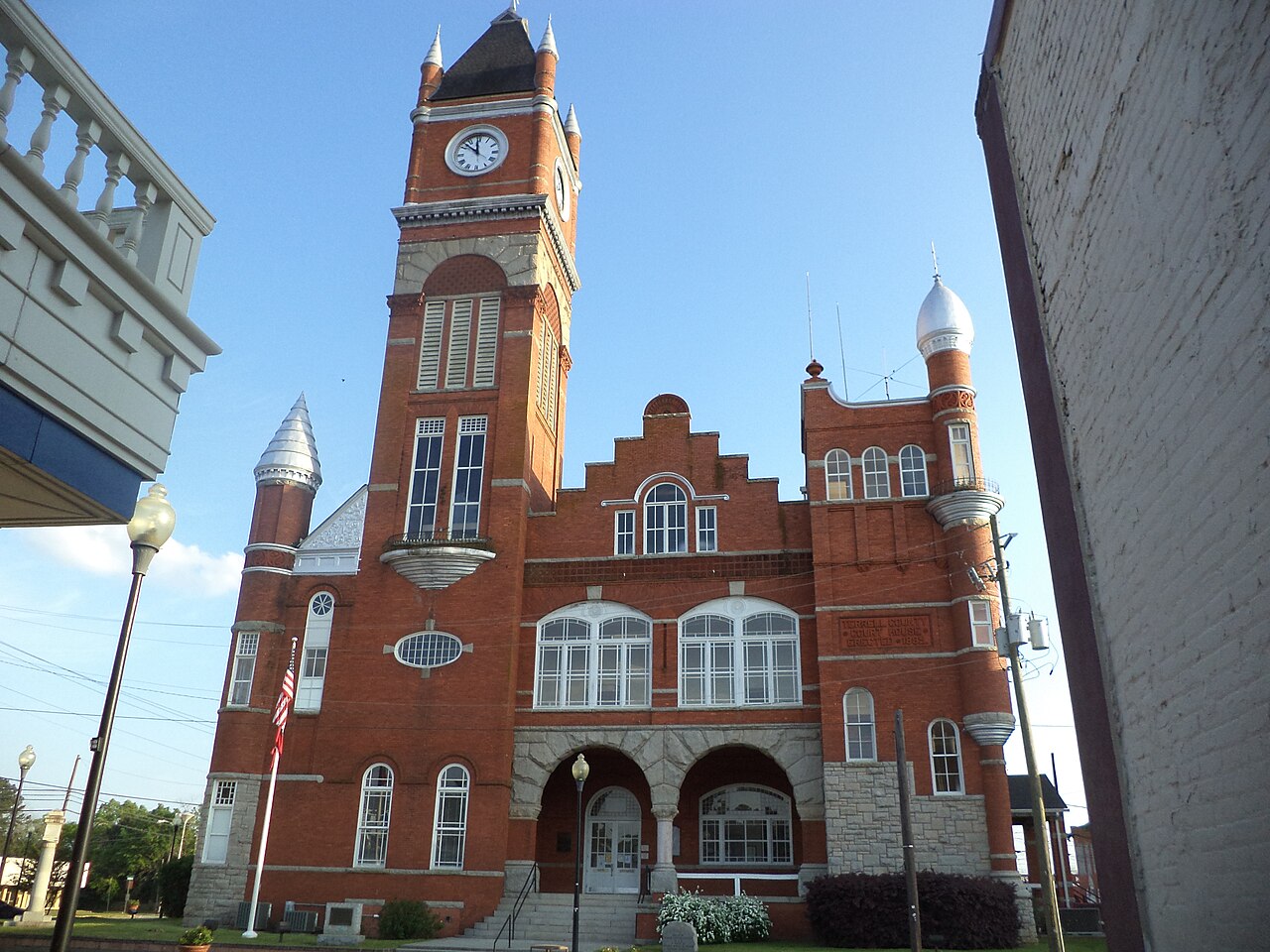
Dawson, Terrell County’s seat, was established on land bought in 1856. The county, with 9,185 residents in 2020, cast 0.09 percent of Georgia’s vote in 2022. Ezekiel Holley, 83 and president of its NAACP, was in his early twenties when white supremacists burned two Baptist churches local activists used to organize, the AP reported in 2024.
Terrell lost 1.4 percent of its population from 2010 to 2020; Macon County lost 18.0. Georgia had 12 counties with more deaths than births in 1994 and 124 in 2021, Charles Hayslett wrote in The Current, many of them once home to textile and manufacturing plants “hammered by NAFTA.”
| County | Ballots cast, 2022 governor’s race against 2018 |
|---|---|
| Dougherty | -15.0% |
| Macon | -10.4% |
| Calhoun | -9.7% |
| Randolph | -8.0% |
| Terrell | -7.2% |
Source: Hesitation Media county calculations from the 2018 and 2022 governor-race returns.
The 53 Black Belt counties cast 5.3 percent fewer ballots in 2022 than in 2018 and moved 5.5 points further toward the Republican than the state between the 2016 and 2020 presidential races. Of 64 majority-Black rural Southern counties, the Daily Yonder reported in 2022, only Early County voted for Trump in 2020.
Sherrell Byrd, executive director of SOWEGA Rising, told the AP, “There’s already underinvestment in rural communities, particularly in Georgia,” and said people there are already politically and economically depressed.
Where to look on election night
Early turnout in the 132 counties Trump carried in 2024 was essentially flat against the same stage of 2022, while ballots in the 27 Harris counties ran 9 percent ahead and Cobb and Gwinnett about 15 percent ahead, Greg Bluestein and Charles Minshew reported in an AJC story updated Oct. 23. Coffee, Colquitt and Laurens were down by double digits.
The county tracker at hesitation.media/election/#counties shows each county against its tied-race margin as the count arrives, and the Senate race is at hesitation.media/election/#race-GA.
- Henry, Rockdale and Douglas: the three counties that moved most between 2018 and 2022.
- Clayton, DeKalb and Fulton: turnout, after Clayton and DeKalb cast fewer ballots in 2022 than in 2018.
- Cherokee and Forsyth for the northern suburbs, Hall for Gainesville and Whitfield for Dalton.
- Dougherty and Terrell for the rural Black Belt; Houston, Columbia and Bryan for the bases and the coast.
The method, caveats and every source are under How we did this.
How we did this
A county’s relative shift is its margin change between the 2018 and 2022 governor’s races minus the state’s (Democrat minus Republican, -1.39 to -7.54 points). A group’s share of movement is its share of the summed absolute vote-weighted relative shifts.
Presidential shifts use the 2016 and 2020 margins against the certified statewide margins. The arithmetic is Hesitation Media’s.
The 27-county ring is the Atlanta MSA less Fulton and DeKalb, the chart’s “Six Atlanta suburbs” plus its “Outer ring,” as grouped in group_summary_GA.csv.
The chart’s Black Belt group, the 53 counties of the Terrell section, is the counties the American Communities Project types African American South outside the metro and the secondary cities.
The rural Black Belt in the Terrell section is a narrower set of 12 middle and southwest Georgia counties: Calhoun, Clay, Dougherty, Early, Hancock, Macon, Quitman, Randolph, Stewart, Taliaferro, Terrell and Warren, 10 of them majority Black in the 2019-2023 American Community Survey.
All 12 lost population between 2010 and 2020. ACP’s African American South type also covers Clayton, Newton, Rockdale and Douglas, all of which grew.
County types are the American Communities Project’s and are credited by name; the project’s data is not reproduced. Scholarly findings are abstract-level and attributed to their authors.
Census figures are the 2010 and 2020 decennial counts and the 2019-2023 ACS five-year profile, pulled from api.census.gov on Nov. 3, 2026.
The Buford Highway photo’s Commons page does not name the county, so the caption does not either. The Dalton photo shows the Crown Mill at 801 Chattanooga Avenue with a lofts banner; the encyclopedia dates Dalton’s Crown Cotton Mill to 1885, and the Commons description does not call the building a carpet mill.
On the county map, two pairs of type colors sit about 9 to 10 CIELAB units apart under simulated color-blindness, so the key and county counts are the reliable reference for those pairs.
| Passage | Figures | Source |
|---|---|---|
| Key numbers; Henry opener | Relative shift +14.09; 2.42% of 2022 vote; ballots -3.03% | Hesitation Media county calculations (county_detail_GA.csv) |
| McDonough founding and seat; Shingleroof Methodist Campground | Laid out on the site of an Indian trading post; incorporated Dec. 17, 1823 (body gives the year), as Henry County’s seat; camp meeting site since 1830 | NGE, “Henry County,” https://www.georgiaencyclopedia.org/articles/counties-cities-neighborhoods/henry-county/ (fetched Nov. 3, 2026) |
| Henry Black growth; Gwinnett gains and losses; Forsyth Asian growth | More than 30,000; nearly 100,000 and nearly 35,000; nearly 90% | AJC, Jennifer Peebles, “Census data shows Georgia continues to diversify,” June 25, 2026, https://www.ajc.com/news/2026/06/census-data-shows-georgia-continues-to-diversify/ |
| 27-county ring; chart | 22.24% + 18.58% = 40.8% of vote; 33.1% + 27.5% = 60.6% of 2018-22 movement; Fulton and DeKalb 18.16% and 7.9% | Hesitation Media group calculations (group_summary_GA.csv) |
| County relative shifts and ballot changes | Rockdale +13.07, Douglas +10.5, Cobb +1.09, Gwinnett +2.17, Houston +4.52, Columbia +4.75, Whitfield -4.04; presidential Gwinnett +7.13; ballots Clayton -8.76%, DeKalb -4.64%, Dougherty -15.01%, Macon -10.41%, Calhoun -9.69%, Randolph -8.03%, Terrell -7.18%; Terrell share 0.092% | county_detail_GA.csv |
| Fulton and DeKalb; north Georgia group; ACP-typed rural group | Net D 405,717 to 348,297; rel. shift -0.23; north Georgia net R -228,430 to -269,166, ballots +7.93%; Black Belt group 53 counties, 8.45%, ballots -5.25%, pres. shift -5.51 | group_summary_GA.csv |
| Black colleges and middle class; AUC | Colleges and growing economic opportunities; 1865, 1867, 1881 | NGE, “Atlanta,” https://www.georgiaencyclopedia.org/articles/counties-cities-neighborhoods/atlanta/ ; NGE, “Atlanta University Center,” https://www.georgiaencyclopedia.org/articles/education/atlanta-university-center/ |
| Metro Black population | More than doubled 1990-2020, topping two million; second only to New York in urban concentration of African Americans | https://www.georgiaencyclopedia.org/articles/history-archaeology/great-migration/ |
| ARC young adults | Nearly 80% of in-flow Black | ARC, “Atlanta Migration Patterns: A Closer Look (pt. 2),” Feb. 2, 2023, https://atlantaregional.org/news/uncategorized/atlanta-migration-patterns-a-closer-look-pt-2/ |
| ACS shares (bachelor’s, race, foreign-born, manufacturing) for all counties and cities named | Fulton 58.0, Clayton 21.3, Henry 28.0, Rockdale 29.1, Douglas 30.8, Newton 23.6, state 34.2; Black: Clayton 68.7, Rockdale 57.1, Henry 49.8, Douglas 48.5, Newton 47.1; Gwinnett foreign-born 27.4, Hispanic 23.2, Black 27.8, Asian 12.8; Norcross 38.8; Duluth 23.4; Dalton 53.3; Whitfield manufacturing 34.6; state manufacturing 10.2; Black Belt majorities | https://api.census.gov/data/2023/acs/acs5/profile?get=NAME,DP02_0068PE,DP02_0094PE,DP03_0035PE,DP03_0042PE,DP03_0033PE,DP05_0076PE,DP05_0082PE,DP05_0083PE,DP05_0085PE&for=county:*&in=state:13 (and the same for place:*) |
| Population change 2010-2020 | Clayton +14.7, Henry +18.0, Newton +12.5, Rockdale +9.8, Douglas +8.9, Forsyth +43.2, Whitfield +0.3; Macon -18.0, Terrell -1.4; all 12 rural Black Belt counties negative | https://api.census.gov/data/2010/dec/sf1?get=NAME,P001001&for=county:*&in=state:13 ; https://api.census.gov/data/2020/dec/pl?get=NAME,P1_001N&for=county:*&in=state:13 |
| Clayton history and airport | 91% white to over 70% Black; home to Hartsfield-Jackson, the state’s largest employer center | https://www.georgiaencyclopedia.org/articles/counties-cities-neighborhoods/clayton-county/ |
| Cobb: Bell and Lockheed | 1942 announcement; B-29 plant in Marietta | https://www.georgiaencyclopedia.org/articles/counties-cities-neighborhoods/cobb-county/ |
| ACP types | Urban Suburbs, African American South, Exurbs, Hispanic Centers, Evangelical Hubs, Graying America, Military Posts | https://www.americancommunities.org/african-american-south/ ; https://www.americancommunities.org/urban-suburbs/ ; https://www.americancommunities.org/exurbs/ ; https://www.americancommunities.org/hispanic-centers/ ; https://www.americancommunities.org/evangelical-hubs/ ; https://www.americancommunities.org/graying-america/ ; https://www.americancommunities.org/military-posts/ ; county assignments from counties.json key GA and county_detail_GA.csv |
| Garner | Rockdale dissertation (ethnographic and interview data; ScholarlyCommons, University of Pennsylvania); abstract: mostly white farming community that diversified; joint worship and service projects; scrutiny for inhospitable or hostile treatment | https://openalex.org/W2788535085 |
| Holt | Three phases; quoted phrase; deteriorating older suburban corridors and international migration; majority-minority 2009 | https://doi.org/10.1108/s1047-0042(2010)0000010005 |
| ARC Asian population | 42,360 (2000); 106,374 (2019) | https://atlantaregional.org/news/uncategorized/data-dive-metro-atlantas-fast-growing-asian-community/ |
| ARDA religion census | Gwinnett Catholic 107,918, SBC 73,648; Hall Catholic 65,020 (3 congregations), SBC 48,511 (60); Cherokee SBC 57,101; Whitfield SBC 25,896, Catholic 20,365 (2 parishes) | https://www.thearda.com/us-religion/census/congregational-membership?y=2020&t=0&c=13135 ; https://www.thearda.com/us-religion/census/congregational-membership?y=2020&t=0&c=13139 ; https://www.thearda.com/us-religion/census/congregational-membership?y=2020&t=0&c=13057 ; https://www.thearda.com/us-religion/census/congregational-membership?y=2020&t=0&c=13313 |
| St. Andrew Kim | 98 to 228 families | https://georgiabulletin.org/news/2013/03/korean-enclave-in-duluth-served-by-st-andrew-kim/ |
| Our Lady of the Americas | About 6,000 members, 2006 | https://georgiabulletin.org/news/2006/07/our-lady-of-the-americas-moves-to-new-lilburn-site/ |
| Kim 2024 | Buford Highway, greater intensity of ICE enforcement under post-2016 administration | https://doi.org/10.1177/0739456x241291292 |
| Mundo Hispanico; Korea Daily | Founded 1979; Atlanta bureau | https://libraries.uga.edu/node/4274 ; https://americancommunitymedia.org/spotlight-ethnic-media/korean-language-daily-looks-to-bridge-generations-and-communities/ |
| AJC print | Dec. 31, 2025; 157 years | Andrew Morse, “A new chapter for the AJC,” Aug. 28, 2025, https://www.ajc.com/opinion/2025/08/a-new-chapter-for-the-ajc/ |
| Dalton carpet; Crown Cotton Mill | 80% within 100 miles; Hispanic workers late 1980s and 1990s, labor shortage; more than 40% by 2000; Crown Cotton Mill opened 1885 | https://www.georgiaencyclopedia.org/articles/counties-cities-neighborhoods/dalton/ ; https://www.georgiaencyclopedia.org/articles/business-economy/carpet-industry/ |
| Poultry workforce change | By the turn of the century | https://www.georgiaencyclopedia.org/articles/history-archaeology/latino-immigration/ |
| Hall poultry | Poultry Capital of the World; most Latino residents in neighborhoods with poverty above 50 percent | https://www.georgiaencyclopedia.org/articles/counties-cities-neighborhoods/hall-county/ |
| Fowler GPB runoff analysis | 310,000; 1,387 precincts; 17 counties, concentrated in northwest Georgia GOP strongholds, others in the northeast | Stephen Fowler, GPB News, “Who Stayed Home More In Georgia’s Senate Runoffs? Rural White Republicans,” April 22, 2021, https://www.gpb.org/news/2021/04/22/who-stayed-home-more-in-georgias-senate-runoffs-rural-white-republicans |
| Fort Benning | 35,000; 287 square miles; renamed | https://www.georgiaencyclopedia.org/articles/counties-cities-neighborhoods/fort-benning/ ; https://www.army.mil/article/283521/hegseth_restores_fort_moore_to_fort_benning_in_honor_of_wwi_soldier |
| Columbia County location | Northwest of Augusta | NGE, “Columbia County,” https://www.georgiaencyclopedia.org/articles/counties-cities-neighborhoods/columbia-county/ |
| Fort Stewart | Half of Liberty County, 1,500 families | https://www.georgiaencyclopedia.org/articles/counties-cities-neighborhoods/fort-stewart/ |
| Savannah port | Nearly 10 percent | https://www.georgiaencyclopedia.org/articles/counties-cities-neighborhoods/savannah/ |
| Hyundai Metaplant | 1,232 (excluding Korean expats) | WTOC, “Hyundai Motor Group holds Grand Opening at Bryan County Metaplant,” March 26, 2025, https://www.wtoc.com/2025/03/26/hyundai-metaplant-holds-grand-opening-bryan-co/ |
| Hyundai expansion | $2.7B; 500,000 | AP (Jeff Amy) via WAFB, “Hyundai says it will spend $2.7 billion expanding part of the Georgia complex raided by ICE,” Sept. 20, 2025, https://www.wafb.com/2025/09/20/hyundai-says-it-will-spend-27-billion-expanding-part-georgia-complex-raided-by-ice/ |
| Dawson founding and seat; Terrell population | County seat, established on 100 acres purchased in 1856; 2020 population 9,185 | https://www.georgiaencyclopedia.org/articles/counties-cities-neighborhoods/terrell-county/ (fetched Nov. 3, 2026) |
| Hayslett | 12 (1994); 124 (2021, the peak); many such counties home to plants hammered by NAFTA from the 1990s | Charles Hayslett/The Daily Yonder via The Current, “Analysis: The hollowing out of rural Georgia – Part 1,” Sept. 27, 2025, https://thecurrentga.org/2025/09/27/analysis-the-hollowing-out-of-rural-georgia-part-1/ |
| Daily Yonder on Early County | 64 counties | Sarah Alexander Melotte, “Rural Counties with the Most Population Loss Voted the Most Democratic in 2020,” Sept. 20, 2022, https://dailyyonder.com/rural-counties-with-the-most-population-loss-vote-the-most-democratic/2022/09/20/ |
| Holley, Byrd | Holley 83, NAACP president, two churches; Byrd quote | AP via GPB, “Activists in rural Georgia seek more robust effort to get Black voters to the polls,” Oct. 17, 2024, https://www.gpb.org/news/2024/10/17/activists-in-rural-georgia-seek-more-robust-effort-get-black-voters-the-polls |
| Early vote | 132 counties flat; 27 counties +9%; Cobb and Gwinnett about 15%; Coffee, Colquitt, Laurens | Greg Bluestein and Charles Minshew, AJC, “Early voting is surging in Georgia suburbs. Rural counties tell another story.,” updated Oct. 23, 2026, https://www.ajc.com/politics/2026/10/early-voting-metro-atlanta-rural-georgia/ (confirmed Nov. 3) |
| Photos | McDonough Historic District; Buford Highway; Crown Mill, Dalton; Terrell County Courthouse, Dawson | visuals/photos/credits.md: Bubba73, CC BY-SA 3.0; Thomson200, CC0; GamblinMonkey, public domain; Michael Rivera, CC BY-SA 3.0, all via Wikimedia Commons |
Changelog
- Published.
Hesitation Media sends new records to the newsletter first. Subscribe on Substack.