Analysis
How Nebraska's 93 counties moved compared with the statewide shift
Dan Osborn's margin against Pete Ricketts is 16.6 points better than the 2022 Democratic margin for governor in unofficial returns; three counties moved toward Ricketts.
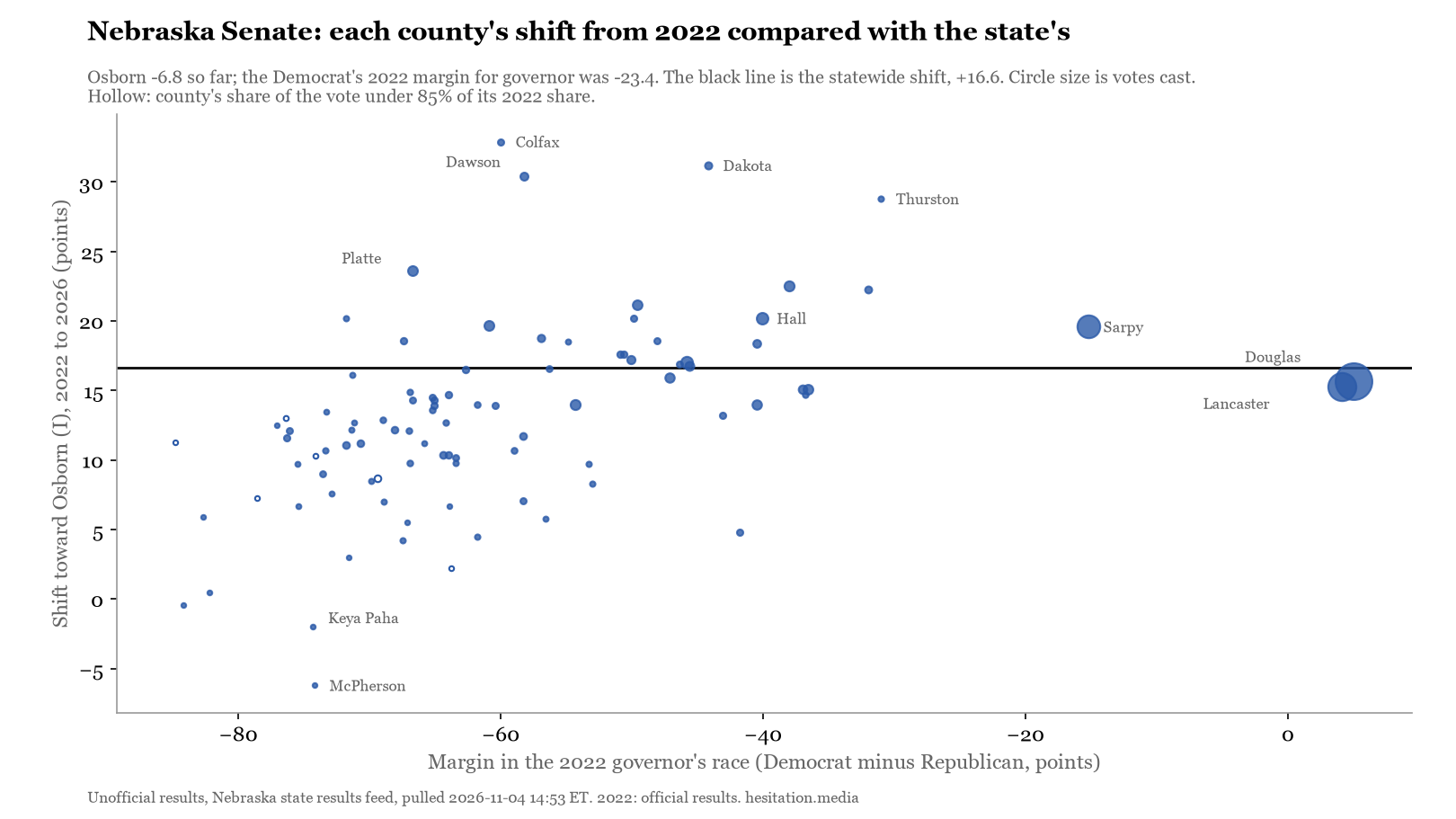
Nebraska’s Senate race had no Democrat. Pete Ricketts (R) ran against Dan Osborn, an independent, so this scorecard compares Osborn’s margin with the closest 2022 statewide race, the governor’s race, in which Jim Pillen (R) beat Carol Blood (D) by 23.4 points. The offices and the candidates differ, so the comparison measures how far Osborn ran from where a Democrat stood in 2022, county by county.
In unofficial returns the state posted at 1:33 p.m. CT on Nov. 4, with all 1,322 precincts reporting, Ricketts led Osborn by 6.8 points, 16.6 points closer than the 2022 governor’s race. Margins are measured against all votes cast, including third-party candidates. On Nov. 3, Hesitation Media published a tied-race mark for each county, which assumed every county would move by the same amount from 2022. In Nebraska that assumption held less well than in Pennsylvania or Ohio. Thirty-one of the 93 counties shifted within 3 points of the statewide change and 49 within 5, and weighted by votes cast, the average county was 2.6 points from where an even statewide shift would have put it.
| County | Votes counted | 2022 governor | 2026 Senate | Shift toward Osborn | Versus the state’s shift |
|---|---|---|---|---|---|
| Douglas | 211,491 | D+5.0 | Osborn +20.7 | 15.7 | −0.9 |
| Lancaster | 122,391 | D+4.1 | Osborn +19.4 | 15.3 | −1.3 |
| Sarpy | 79,412 | R+15.2 | Osborn +4.4 | 19.6 | +2.9 |
| Buffalo | 19,252 | R+45.8 | R+28.8 | 17.0 | +0.4 |
| Hall | 18,115 | R+40.1 | R+19.9 | 20.2 | +3.5 |
| Dodge | 12,936 | R+38.0 | R+15.5 | 22.5 | +5.9 |
| Lincoln | 12,712 | R+54.3 | R+40.3 | 14.0 | −2.5 |
| Madison | 12,131 | R+60.9 | R+41.2 | 19.7 | +3.1 |
| Platte | 12,068 | R+66.7 | R+43.1 | 23.6 | +7.1 |
| Cass | 11,843 | R+36.6 | R+21.5 | 15.1 | −1.6 |
Where the counties moved more than the state
Colfax County shifted 32.9 points toward Osborn, the largest move in Nebraska, from a 60.0-point Pillen margin to a 27.1-point Ricketts margin. Dakota shifted 31.2 and Dawson 30.4, and the American Communities Project classes all three as Hispanic Centers. Thurston, which shifted 28.8 points, lies within the Omaha and Winnebago reservations. Sarpy, south of Omaha, went from a 15.2-point Pillen margin to a 4.4-point Osborn lead.
Where the counties moved less than the state
Douglas and Lancaster, which contain Omaha and Lincoln and were the only counties Blood carried in 2022, shifted 15.7 and 15.3 points, a little less than the state. The 52 counties the American Communities Project classes as Aging Farmlands shifted 11.4 points, weighted by votes, about 5 points less than the state. Three of them moved toward Ricketts: McPherson by 6.2 points, Keya Paha by 2.0 and Grant by 0.4.
Votes, 2022 to 2026
In the unofficial returns, 739,692 votes were cast in the Senate race, 11 percent more than the 666,795 cast for governor in 2022. Osborn’s 322,625 votes were 33 percent more than Blood’s 242,006, and Ricketts’s 373,115 were 6 percent fewer than Pillen’s 398,334. Republican votes fell in 72 of the 93 counties, rose in 20, most of them rural counties in the center and north of the state, among them Buffalo and Hall, two of the largest, and were unchanged in one. County returns cannot show whether 2022’s voters switched sides or did not vote, and the change of office and candidates means some of the difference reflects the candidates themselves. The 2022 figures are county returns compiled by the MIT Election Data and Science Lab (MEDSL).
Unofficial returns and certification
The results remain unofficial until certification. In six counties, the share of the statewide vote is less than 85 percent of the county’s 2022 share: Arthur, Banner, Custer, Dundy, Hooker and Sioux.
Changelog
- Published with unofficial returns the state posted at 1:33 p.m. CT Nov. 4, with all 1,322 precincts reporting. This piece updates at certification.
Hesitation Media sends new records to the newsletter first. Subscribe on Substack.