Analysis
How North Carolina's 100 counties moved compared with the statewide shift
Roy Cooper's margin moved 22.8 points from the 2022 Senate race in unofficial returns, and 48 of North Carolina's 100 counties moved within 3 points of the state's.
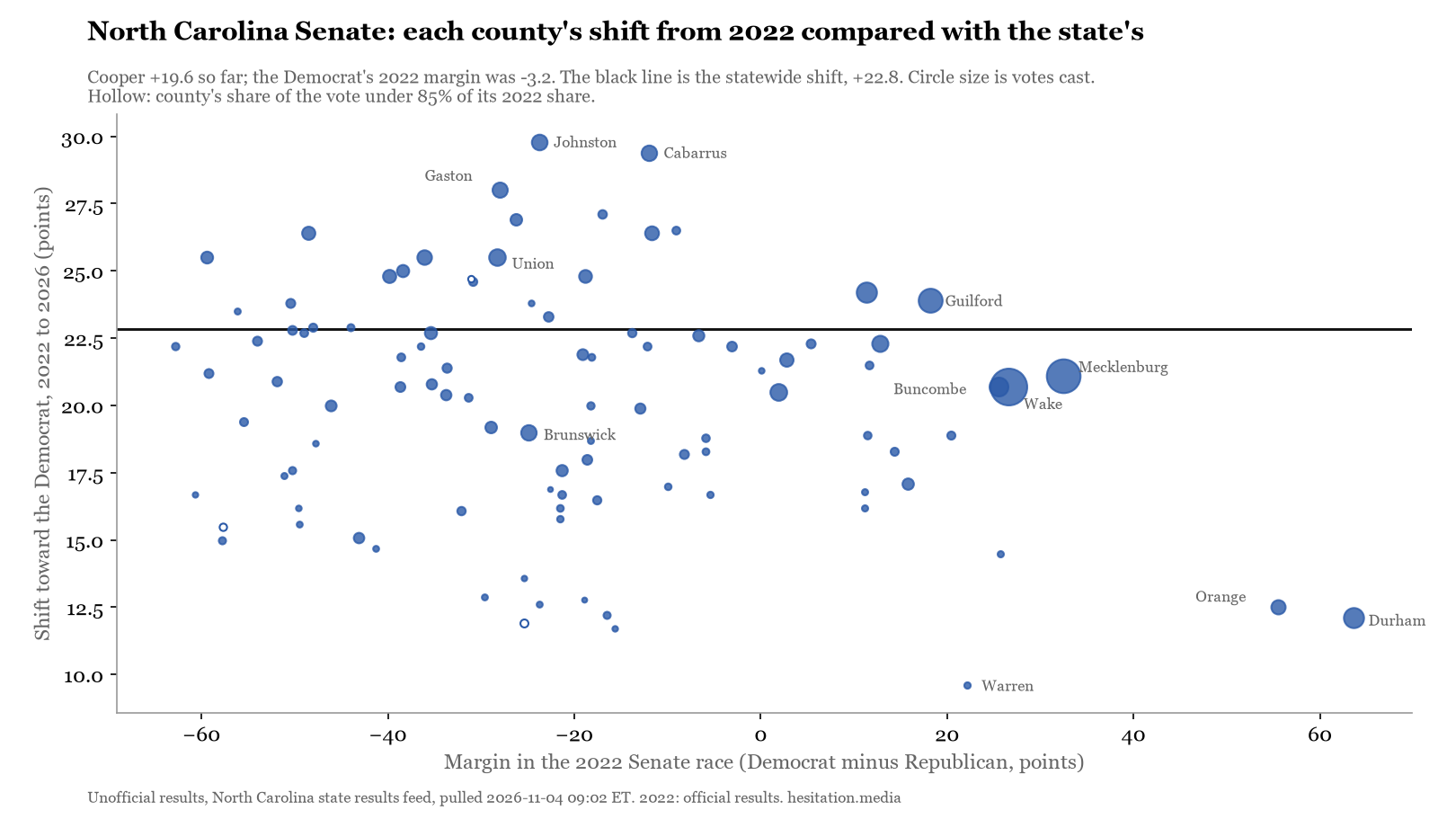
On Nov. 3, Hesitation Media published a tied-race mark for each of North Carolina’s 100 counties: the margin the county would post if the Senate race ended even and every county moved by the same amount from the 2022 Senate race, which Ted Budd (R) won over Cheri Beasley (D) by 3.2 points. In unofficial returns the state posted at 6:40 a.m. on Nov. 4, Roy Cooper (D) led Michael Whatley (R) by 19.6 points, a shift of 22.8. This page compares each county’s change since 2022 with that statewide change, which checks whether every county moved by about the same amount, as the marks assumed.
Forty-eight of the 100 counties shifted within 3 points of the statewide change, and 65 within 5. Weighted by votes cast, the average county was 3.2 points from where an even statewide shift would have put it, between Pennsylvania’s 1.8 and Georgia’s 4.7.
| County | Votes counted | Tied-race mark | 2022 | 2026 so far | Shift toward Cooper | Versus the state’s shift |
|---|---|---|---|---|---|---|
| Wake | 523,237 | D+29.8 | D+26.6 | D+47.3 | 20.7 | −2.1 |
| Mecklenburg | 439,955 | D+35.7 | D+32.5 | D+53.6 | 21.1 | −1.7 |
| Guilford | 217,239 | D+21.5 | D+18.2 | D+42.1 | 23.9 | +1.0 |
| Forsyth | 152,572 | D+14.5 | D+11.3 | D+35.5 | 24.2 | +1.3 |
| Durham | 150,482 | D+66.9 | D+63.6 | D+75.7 | 12.1 | −10.9 |
| Buncombe | 131,206 | D+28.7 | D+25.5 | D+46.2 | 20.7 | −2.1 |
| New Hanover | 102,740 | D+5.1 | D+1.9 | D+22.4 | 20.5 | −2.3 |
| Union | 100,583 | R+25.1 | R+28.3 | R+2.8 | 25.5 | +2.6 |
| Cumberland | 95,138 | D+16.1 | D+12.8 | D+35.1 | 22.3 | −0.6 |
| Johnston | 88,773 | R+20.6 | R+23.8 | D+6.0 | 29.8 | +7.0 |
| Cabarrus | 86,912 | R+8.8 | R+12.0 | D+17.4 | 29.4 | +6.6 |
| Brunswick | 86,688 | R+21.7 | R+24.9 | R+5.9 | 19.0 | −3.9 |
Where the counties moved more than the state
Johnston County shifted 29.8 points toward Cooper, from a 23.8-point Republican margin in 2022 to a 6.0-point Democratic one, the largest shift in North Carolina. Cabarrus shifted 29.4 points, from R+12.0 to D+17.4, and Gaston 28.0, from a 28.0-point Budd margin in 2022 to within a tenth of a point of even. Johnston borders Wake County; Cabarrus, Gaston and Union, which shifted 25.5, border Mecklenburg. The returns do not show why these counties moved more.
Where they moved less
Durham and Orange, the two counties that gave Beasley her largest margins in 2022, shifted 12.1 and 12.5 points, the smallest moves among counties with more than 50,000 votes. Warren shifted 9.6, the smallest in the state. Wake and Mecklenburg, the two counties with the most votes, shifted 20.7 and 21.1, about 2 points less than the state.
Votes, 2022 to 2026
The Senate race drew 4,203,181 votes in the unofficial returns, 11 percent more than the 3,773,555 cast in the 2022 general election. Democratic votes rose 38 percent, from 1,783,875 to 2,467,963, and Republican votes fell 14 percent, from 1,905,603 to 1,643,088. Republican votes fell in 99 of the 100 counties and rose by 25 votes in the exception, Brunswick. County returns cannot show whether 2022’s Republican voters switched sides or did not vote. The 2022 figures are county returns compiled by the MIT Election Data and Science Lab (MEDSL).
What is still being counted
Three counties hold a share of the 2026 vote that is less than 85 percent of their share of the 2022 vote, which can mean votes there are still outstanding: Alexander, Columbus and Yancey.
Changelog
- Added the section on votes cast and each party's votes, 2022 to 2026.
- Published with unofficial returns the state posted at 6:40 a.m. ET. This piece updates as counties finish and again at certification.
Hesitation Media sends new records to the newsletter first. Subscribe on Substack.