Analysis
How close the tied-race marks came, in five states
The average county finished 2.8 points from where a uniform statewide shift put it, closest in Pennsylvania and Ohio. Proportional swing would have missed by 2.3.
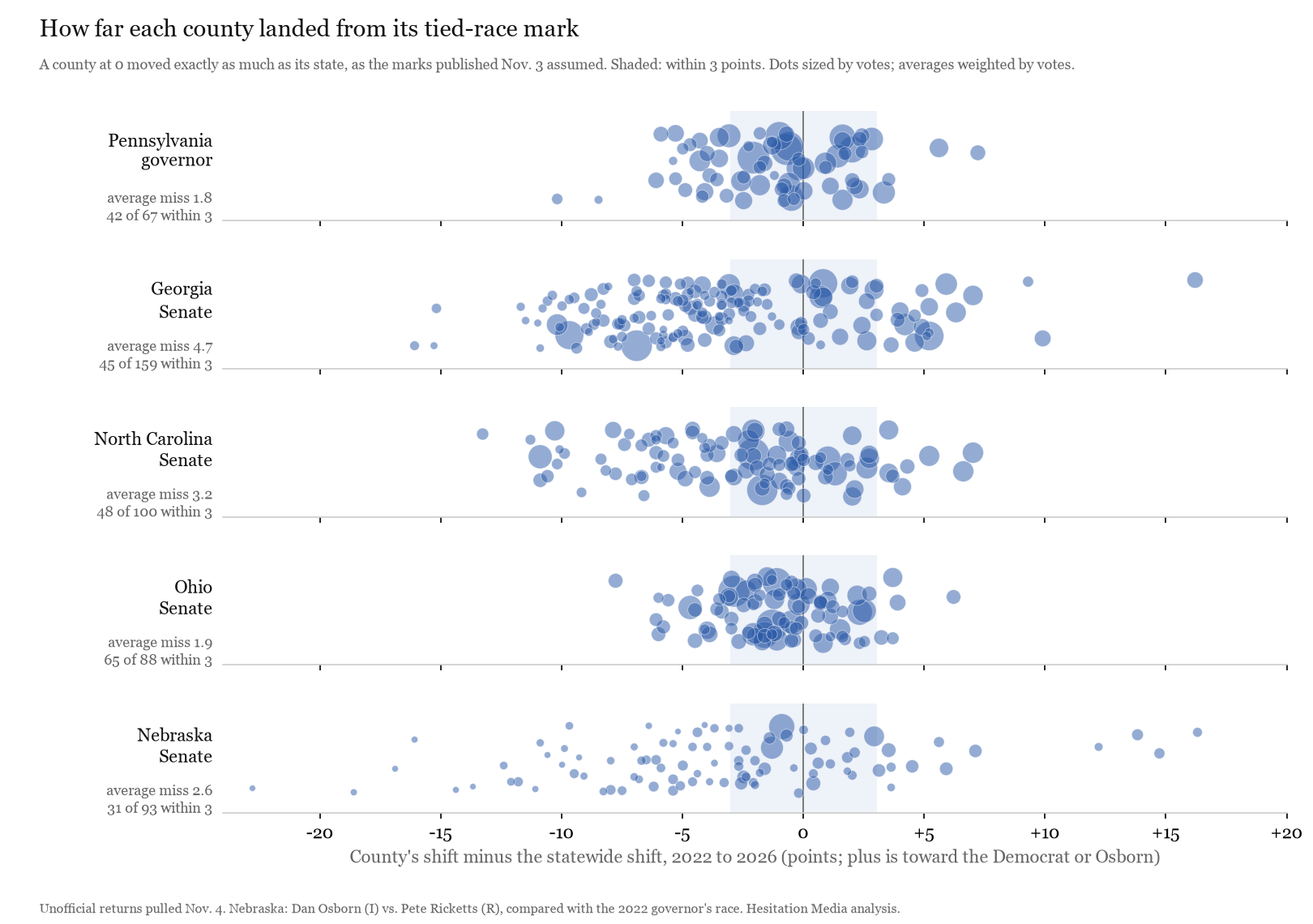
On Nov. 3 Hesitation Media published a tied-race mark for every county in five states: the margin the county would post if the race ended in a tie and every county moved by the same number of points from 2022. None of the races ended near a tie, so the returns can test only the second half of that assumption, the uniform shift. Across the 507 counties, weighted by votes, the average county finished 2.8 points from where a uniform statewide shift would have put it, and counties casting 68.9 percent of the votes finished within 3 points. The assumption held best in Pennsylvania and Ohio and worst in Georgia, and a different method, proportional swing, would have missed by 2.3 points on average.
Each state
| State and race | Statewide shift, points | Average miss, points | Counties within 3 points | Votes in counties within 3 | Average miss with proportional swing |
|---|---|---|---|---|---|
| Pennsylvania governor | 6.7 | 1.8 | 42 of 67 | 81.8% | 2.0 |
| Ohio Senate | 11.0 | 1.9 | 65 of 88 | 86.4% | 1.6 |
| Nebraska Senate | 16.6 | 2.6 | 31 of 93 | 76.4% | 3.0 |
| North Carolina Senate | 22.8 | 3.2 | 48 of 100 | 68.2% | 2.5 |
| Georgia Senate | 17.0 | 4.7 | 45 of 159 | 34.0% | 3.2 |
| All five | 2.8 | 231 of 507 | 68.9% | 2.3 |
Where the uniform shift missed
In Georgia the most Democratic and the most Republican counties tended to move less than the state, though not all of them. The three counties where Raphael Warnock (D) won by the widest percentage margins in 2022, among all 159, moved less than the state: Fulton by 6.9 points, DeKalb by 9.7 and Clayton by 10.2. Gwinnett, a Democratic county by 20 points in 2022, moved 5.2 points more than the state, and Whitfield, a Republican county by 46 points whose seat is Dalton, moved 16.2 more. One plausible reading is that a county already voting 70 points one way has less room to move than a closely divided county. Proportional swing allows for that limit, and its smaller misses here fit that reading without proving it. Proportional swing cut the average Georgia miss from 4.7 points to 3.2, and North Carolina’s from 3.2 to 2.5.
Nebraska’s largest misses were in its smallest counties. McPherson, with 230 votes counted, landed 22.8 points short of its mark, Keya Paha 18.6 and Grant 16.9; Colfax, which the American Communities Project classes as a Hispanic Centers county, moved 16.3 points more than the state. Because the averages are weighted by votes, those counties barely move Nebraska’s average miss of 2.6 points. Proportional swing raised Nebraska’s average miss to 3.0.
The two methods
Proportional swing would have missed by 2.3 points on average across the five states instead of 2.8. It did better in Georgia, North Carolina and Ohio and worse in Pennsylvania and Nebraska.
Every 2026 figure here is unofficial. Pennsylvania had counted about 91 percent of its 2022 total when these returns were pulled, and this page updates when the states certify.
Changelog
- Published with the unofficial county returns behind parts 1 to 5, pulled Nov. 4. This piece updates when those parts update.
Hesitation Media sends new records to the newsletter first. Subscribe on Substack.